


The First Naval Drone Battle: Ukraine's Sargan Sinks a Russian Drone Boat in the Black Sea

Updated: Oct 6

Somewhere in the Black Sea on September 12, two boats fought a naval engagement with not a single human aboard either hull. Ukraine's Navy says its Sargan 3000 strike drone found a Russian uncrewed boat, opened fire from about a kilometer out with a 12.7 mm remote turret, and put it on the bottom. "This is the first naval battle in history between unmanned boats," the Navy said. The claim has not been independently verified, and the Kyiv Independent and TWZ both flag that caveat, but nobody has produced a counterexample. The first naval drone battle has a date, and the channel has been waiting for this one for two years.
The last 48 hours were loud everywhere else too: Russia threw roughly 500 strike drones across Ukraine in a single wave, reaching rarely hit Volyn and Rivne oblasts in the west, and a Russian drone struck the Kyiv-Warsaw passenger train near the Polish border during nationwide attacks that killed six and injured 43, per the Kyiv Independent. Ukraine answered at refineries in Krasnodar and Tatarstan. But the item that changes doctrine is the small gunfight at sea. Walk through it with us.
How the First Naval Drone Battle Went: One Kilometer, No Crew
The operation was a Navy and HUR joint effort: military intelligence units detected the Russian boat, and the Navy's Sargan 3000 ran the intercept. Per details published by United24 Media and Militarnyi, the Sargan opened fire from roughly one kilometer, deliberately shredding the target's radio antennas first to cut its operators out of the loop. The Russian boat tried to run, took multiple hits at closing range, and sank on camera.
The weapon that did the work is telling. The Sargan carried a Kongsberg Protector remote weapon station with a 12.7 mm machine gun, a NATO-standard turret normally bolted to armored vehicles, stabilized and aimed by an operator far over the horizon. Naval News, which places the fight in the northwestern Black Sea between Odesa and Crimea, identified the destroyed Russian craft as an improved Orcan type, also reported as Zefir: a fast, jet-ski-propelled attack boat conceptually similar to Ukraine's own Magura V5. One caveat we will echo from TWZ: the Russian boat appears to have been unarmed against surface targets and could not shoot back. This was a hunt, not a duel. The duels come next.

A CROWS remote weapon station of the Kongsberg Protector family, the same turret line the Sargan 3000 carries at sea. Photo: US Army, public domain, via Wikimedia Commons
The Sargan 3000: From the Izumrud to Drone Killer
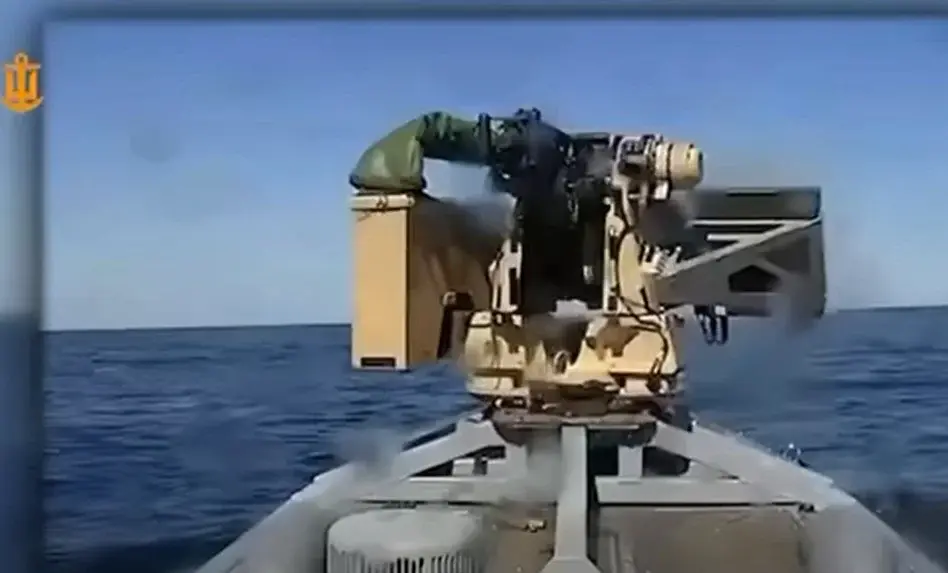
The Sargan 3000 strike drone. Photo: Ukrainian Navy via ArmyInform, CC BY 4.0
The Sargan 3000 is the Ukrainian Navy's multipurpose strike drone, formally adopted in April 2026, when President Zelensky publicly named it alongside Sea Baby and Magura V5 as the fleet's uncrewed backbone, per ArmyInform. The published figures: up to 1,600 km operational radius, 40 to 55 knots, 450 kg of payload, satellite-linked with jam-resistant navigation, and built in variants that carry guns, rockets, FPV drones, electronic warfare kits, or mines.
It already had a kill list. In July 2026 a Sargan sank the FSB border patrol ship Izumrud, a Project 22460 cutter, near Novorossiysk, per Militarnyi. That ship was one of the vessels involved in Russia's 2018 attack on Ukrainian boats in the Kerch Strait, which gave the strike a certain bookkeeping quality. The step from killing a patrol ship to killing another drone is smaller than it looks: the hard part is finding a small, fast contact at sea and holding a stabilized gun on it. That is exactly the skill set that turns a strike drone into a picket, and a picket line of gun-armed Sargans is how you defend a coastline against what Russia is building.
Russia's Drone Fleet: Donuzlav, the Orcan, and the Odesa Problem
Because Russia is building. Moscow started chasing Ukraine's USV lead around 2022 and spent years hobbled by the lack of a Starlink equivalent, per Defense Express. The workaround it settled on, described by Naval News and by Ukraine's Navy: real-time control via relay, with Geran-type aerial drones providing surveillance and radio bridge. Navy spokesperson Dmytro Pletenchuk described exactly that architecture in May, when Russian naval drones launched from occupied Crimea and the Krasnodar region attacked three merchant ships in Ukraine's grain corridor at night, controlled "via telemetry, that is in real time," injuring two civilian sailors.
The infrastructure is getting serious. Satellite imagery analyzed by Defense Express shows Russia has been building its first dedicated naval drone port on Lake Donuzlav in occupied Crimea since February: 21 camouflaged shelters, workshops, and antenna farms, possibly operational this month. Naval News adds a second basing point at Chornomorske in northwestern Crimea. Russia's first confirmed USV hit on a Ukrainian warship came in August 2025, against the intelligence ship Simferopol, per TWZ. And Militarnyi's read on Saturday's kill is that the destroyed boat was likely headed for the ports of Greater Odesa or the merchant traffic feeding them. Ukraine's Navy has been intercepting these for months, including a Russian naval drone destroyed short of Odesa in April, per the General Staff. The difference this time: the interceptor had no crew either.

A Russian naval drone destroyed at sea before reaching Odesa, April 2026. Photo: General Staff of the Armed Forces of Ukraine via ArmyInform, CC BY 4.0
Why It Matters
Every navy on earth just got a preview of its next fleet problem. The Black Sea has been the laboratory of uncrewed naval war since 2022, and the experiments keep escalating: kamikaze boats, then FPV carriers, then boats that shoot down helicopters and jets, and now boat-on-boat gunnery. The US Navy is a customer of the lesson too; CENTCOM ran its first drone boat strike with Corsair USVs against Iran's Bandar Abbas naval base in July, per TWZ. Once both sides of a war operate armed autonomous hulls from hidden coastal shelters, sea control stops being a question of who has ships and becomes a question of who finds, jams, and kills small robots faster. Saturday's engagement, one-sided as it was, is the first data point in that ledger.
For Ukraine specifically, this is coastal defense economics. An Orcan that reaches Odesa trades a cheap hull for a pierside ship, a grain terminal, or a blackout. A Sargan that kills it far offshore trades machine gun ammunition. That math is why the Navy is arming its drones with turrets instead of only warheads.
What to Watch
Watch for the first true duel: two armed USVs that can both shoot. TWZ notes weapons are going to sea on both sides' drones fast, and the one-sided hunts will not stay one-sided. Watch Donuzlav: if the shelter count grows or Ukraine strikes it, that tells you how operational the base really is. Watch the Geran relay layer: killing the airborne radio bridge may become the standard counter to Russian USV raids. And watch the grain corridor: Russia's drone boats exist mostly to re-threaten what its fleet can no longer approach.
The channel covers the Black Sea drone war as it happens, often hours before the wires. Follow t.me/TheLeaflet for the live feed, and The Daily Sitrep here every morning for the deep read.
Read next: The Sochi Drone Attack: Ukraine's Sea Drones Just Reached Putin's Riviera and The Admiral Essen Is Burning: Ukraine Returns to Novorossiysk to Finish the Job.
Want the recap in your inbox? The channel sends one Sitrep Digest email on the 1st of each month, the best of the morning briefs in a five minute read. Drop your email in the subscribe box at the bottom of this page.
Sources
Ukrainian Navy and HUR statements via ArmyInform; Kyiv Independent; TWZ; Naval News; Militarnyi; United24 Media; Defense Express; Euromaidan Press. Photos: Ukrainian Navy and the General Staff via ArmyInform (CC BY 4.0); US Army via Wikimedia Commons (public domain).


Comments