


The Graham Sanctions Bill Passes: 100 Percent Tariffs on Russia's Oil Buyers Are Now One Signature Away


Lindsey Graham did not live to see the vote. The Russia sanctions package he introduced in April 2025 and carried through seventeen months of stalls, rewrites, and White House negotiations passed the House on September 16 by 262 to 159, carrying his name: the Lindsey O. Graham Sanctioning Russia and Iran Act of 2026. The Graham sanctions bill now sits on President Trump's desk, and he is expected to sign it.
If he does, the United States will hold a legal instrument it has never had in this war: authority to hit the countries bankrolling Moscow's invasion, not just Moscow itself. The same night the House voted, Russia answered with ballistic missiles and drones across eight regions of Ukraine, including at least ten explosions in Kyiv on Thursday morning.
What the Graham sanctions bill actually does

Photo: Architect of the Capitol, public domain, via Wikimedia Commons
The core of the law is tariff authority. The president can impose duties of up to 100 percent on the top five purchasers of Russian oil and natural gas, and on countries that help Moscow evade sanctions, per RFE/RL and CBS News. Countries importing less than 15 percent of their gas from Russia while verifiably cutting further are exempt, and the president can waive any measure he certifies as in the US national interest.
Around that core, the bill layers sanctions on Russian officials up to and including Putin, on banks and financial institutions, on the energy sector, and on the shadow fleet of aging tankers that moves Russian crude outside Western insurance, per Roll Call. It extends the Iran Sanctions Act by five years, to 2031, at the White House's request. All Russia measures sunset after five years.
Note the verbs. The law authorizes; it does not compel. Every trigger is pulled, or not pulled, by the president. House Democratic leadership opposed it on exactly those grounds: Rep. Don Beyer warned the tariff provision lets Trump "define basically any country as a facilitator" and "hit them with tariffs of up to 100%, with no guardrails or oversight," per NPR; Leader Hakeem Jeffries argued its loopholes mean the pressure may never land. Fifty-eight Democrats voted yes anyway. Seven Republicans voted no.
From 500 percent to a dead man's signature

Photo: US Senate official portrait, public domain, via Wikimedia Commons
The original Sanctioning Russia Act, introduced by Graham and Democrat Richard Blumenthal on April 1, 2025, proposed 500 percent tariffs and gathered 84 Senate cosponsors. Graham called it an economic bunker buster. It sat for more than a year while the White House pursued direct talks with Putin; Trump formally endorsed a softened version in January 2026 after negotiating the rewrite with Graham personally.
Graham died suddenly this past July, days after returning from Kyiv, where he had announced the deal with the White House on the updated bill, per CBS News. His death did what his advocacy could not: the Senate renamed the package after him and passed it 86 to 11 on August 7, with Zelensky, in Washington for the funeral, watching the procedural vote from the gallery, per Roll Call. A Rand Paul and Ron Wyden amendment to strip the tariff authority failed 32 to 64. Per Al Jazeera, it is the first Ukraine support legislation to clear Congress in more than two years.
Blumenthal's message on passage was aimed past Moscow: "To Vladimir Putin, we have your number," and to China and India, "buy your oil and gas somewhere else," per RFE/RL. Speaker Mike Johnson called it maximum pressure on Putin and his enablers. Zelensky called the bill "an extremely powerful tool that can stop this terrorist war and bring Russia to the point where it has to make peace."
The top five buyers have names and invoices
Who actually gets tariffed? The Centre for Research on Energy and Clean Air's August ledger names them. China bought EUR 8.4 billion in Russian fossil fuels that month, roughly half of what Moscow's top customers paid. India took EUR 4.8 billion, 87 percent of it crude. Turkey bought EUR 1.5 billion. Fourth place is uncomfortable: the European Union, at EUR 1.2 billion, mostly pipeline gas and LNG. Egypt rounds out the five at about half a billion.
The same CREA analysis shows what the bill is trying to finish. Russia's fossil fuel export revenue fell 8 percent in August to EUR 604 million a day, oil product exports hit their lowest level of the full-scale war, and sanctioned shadow tankers, the fleet this law targets by name, carried 52 percent of Russia's seaborne oil. Strangest of all, Russia imported 172,000 tonnes of refined fuel, seven times its previous monthly record, 70 percent of it from India: gasoline refined at a plant partly owned by Rosneft and shipped back on sanctioned tankers. Russia is buying back its own oil because it cannot refine enough at home.
The war did not wait for the vote
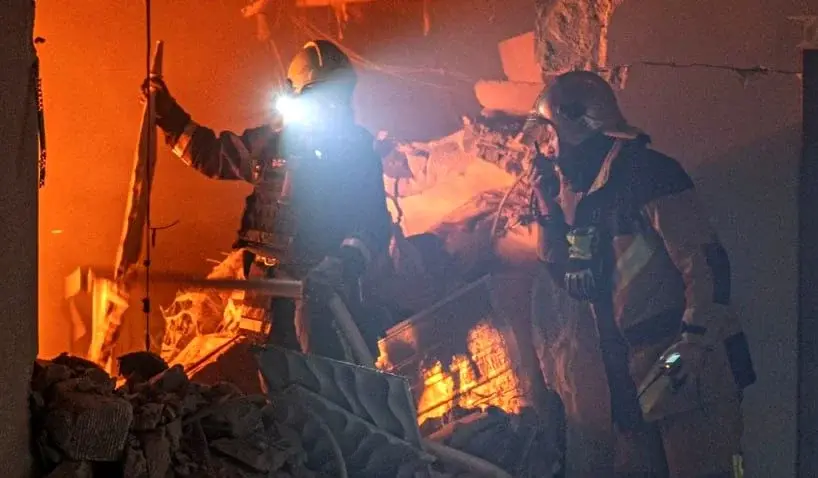
Photo: ArmyInform, CC BY 4.0
That refining collapse is not an act of markets. On the day of the House vote, Reuters reported that Rosneft's Syzran refinery halted after a drone strike damaged the crude unit carrying 71 percent of its capacity, and that Saratov shut down just as it was about to restart: roughly 290,000 barrels per day offline, with three of Russia's six biggest diesel producers now sharply reduced or fully stopped, per Reuters via the Moscow Times. The channel has tracked this campaign for months: Ukraine's drones have been imposing, kinetically, the export pain this bill promises economically.
Moscow's response covered both tracks. The Kremlin's Dmitry Peskov called the House vote "an unfriendly action" and said new sanctions "will certainly hinder efforts to peacefully settle the Ukrainian conflict," per TASS. The missiles said the same thing louder: Oniks, Iskander-M and KN-23 ballistic missiles, Kalibr cruise missiles and more than 150 drones overnight, per ArmyInform. Per Ukrinform, sixteen people were injured in Kyiv, including children aged 10 and 12; AP counted at least nineteen hurt nationwide.
Why it matters
Since the Witkoff and Kushner shuttle produced no deal this month, Washington's Russia policy has had a diplomacy track and no pressure track. This law builds the pressure track, and it is aimed at the actual load-bearing wall of the Russian war economy: the buyers. But its weight depends on a president who spent seventeen months not wanting it, then negotiated its edges soft. A 100 percent tariff on China or India would be a genuine economic weapon. A signed law that is never invoked is a paperweight with a dead man's name on it.
What to watch
Whether Trump signs this week, and what he says when he does. Whether the first tariff designation ever comes, and whether it names a partner like India or an adversary like China first. Whether Moscow's pre-announced winter energy campaign escalates in answer. And whether the EU trims its own EUR 1.2 billion a month before asking others to.
The channel will be watching the signature line. For the daily tape as it happens, we run it live at t.me/TheLeaflet, and the morning read is here every day in The Daily Sitrep.
Read next: Jilin Chemical Fiber: The Chinese State Firm in Russia's Shahed Supply Chain, and the Night the Truce Ended | The Azov Padlock: 242 Ships, a 90 Percent Collapse, and Six Weeks of a Closed Kerch Strait
Want the recap in your inbox? The channel sends one Sitrep Digest email on the 1st of each month, the best of the morning briefs in a five minute read. Drop your email in the subscribe box at the bottom of this page.
Sources
Reporting for this brief draws on RFE/RL, NPR, CBS News, Roll Call, Al Jazeera, New Voice of Ukraine, the Centre for Research on Energy and Clean Air, Reuters via the Moscow Times, Ukrinform, the Kyiv Post, the Associated Press, ArmyInform, and TASS (Russian state media, for Kremlin statements). Photo credits appear beneath each image.


Comments