


Algeria Enforced Disappearances: The Law They Barely Needed (Cold Files 025)

On a Wednesday morning in April 2026, police in central Algiers arrested a man standing with a small group of women outside a government human rights commission. The gathering had been happening on that spot, on and off, since 1998. The women were mothers. The man was a relative of someone taken in the 1990s who never came back, and his unpaid job was to keep the gathering going. He was tried the following day. The charge was unarmed assembly.
Part of the Cold Files series.
Nothing in that sentence required a memory law, a state secret, or a denial. Algeria has never denied that thousands of people were taken from their homes and workplaces between 1992 and 1998 and never seen again. It counted them. It paid their families. It issued them certificates. What it has not done, in thirty-four years, is tell a single family who took their relative.
The count already existed
The story usually starts in September 2003, when President Abdelaziz Bouteflika announced a commission on the disappeared. By then the counting had been going on for years.
Reception offices run by the Interior Ministry had registered 4,884 cases by 31 March 2001, according to the Collectif des Familles de Disparu(e)s en Algerie. In January 2003 Le Monde reported that the national gendarmerie had acknowledged 7,046 complaints. Farouk Ksentini, the lawyer who would chair the new body, told Human Rights Watch in November 2002 that the total ran to 7,000 or 10,000 cases, and possibly 12,000.
So the 2003 mechanism did not create a count. It consolidated one. Its own decree says so: its first listed task was the "centralization and consolidation of all facts related to the question of 'the disappeared'."

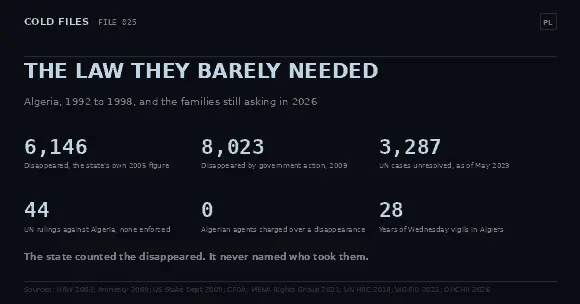
The number it settled on was 6,146, which Ksentini gave to La Tribune on 9 March 2005 and repeated to Jeune Afrique the following month. Four years later, at a Geneva conference in March 2009, commission representatives put a different figure on the record: 8,023 people missing or disappeared as a result of government actions.
Set that against the international register. The United Nations Working Group on Enforced or Involuntary Disappearances had transmitted 3,316 Algerian cases to the government as of May 2023, of which 29 had been clarified, 9 of them by Algeria itself, leaving 3,287 outstanding. Independent tallies run both lower and much higher: the Collectif has compiled 4,635 individual case files, while the Algerian League for the Defence of Human Rights has been reported at 18,000.
That high figure is an estimate rather than a case list, and the honest range is the documented one. But note which way the asymmetry runs. The state's own working figure is larger than the UN's register. This is not a government suppressing a count.
An interface, not an inquiry
Presidential decree 03-299 of 11 September 2003 created the ad hoc mechanism on the disappeared inside the existing national human rights commission.
Read the mandate and the architecture is unmistakable. The body was to consolidate facts, to assist in "determining the whereabouts of persons declared as 'disappeared'", to "ensure regular communication with the families", and to press the authorities to identify bodies that were found. It had seven members, none of them a representative of the families and none of them a lawyer acting for them.
Bouteflika said publicly that it "must not be seen as a commission of inquiry." In March 2003, before his appointment, Ksentini had argued for exactly the opposite: a commission of inquiry that would, unlike the human rights commission he already chaired, investigate case by case. He asked for an inquiry and was given an interface.

Here precision matters more than indignation, and it is worth being exact because the looser version is wrong. The decree did not forbid the mechanism from establishing who took people. It simply never mentioned it. Amnesty International found the body had no mandate to clarify the fate of the disappeared or to identify those responsible, and no power to review archives or subpoena officials. Human Rights Watch catalogued the same absences: no power to compel testimony or documents, no right to inspect sites at will, no penalty for an official who declined to cooperate.
The mandate expired on 31 March 2005. Neither the list of cases nor the final report was ever published.
Ksentini's own formula for what his inquiry had found became the government's position. Interviewed by Jeune Afrique on 11 April 2005 under the headline "Responsable mais pas coupable", responsible but not guilty, he said the disappearances were the work of certain state agents acting individually, that the state was civilly responsible for its agents' unlawful acts, and that the disappearances had not been organised or ordered by state institutions.
The price of payment was a death certificate
The Charter for Peace and National Reconciliation went to a referendum on 29 September 2005. Ordinance 06-01 of 27 February 2006 implemented it.
Article 37 of that ordinance made compensation for a family of a disappeared person conditional on obtaining a judgement declaring the person dead. Decree 06-94, issued the next day, covered families of "persons implicated in terrorism" and required a judicial police certificate that the relative had died in the ranks of terrorist groups. Families had one year to obtain a missing-person certificate and six months after that to lodge a claim.
So the sequence a family faced was this. Go to court. Obtain a ruling that your son is dead. You will not be told how he died, or when, or where, or at whose hands, because no body was authorised to establish any of that. Then collect the money.

Most families went. Algeria told the UN Human Rights Committee in October 2007 that 6,233 of 11,547 applications had been approved, for more than 2.8 billion dinars. By December 2008 the Ministry of Social Solidarity put it at 7,103 claims settled and 5.4 billion dinars. The head of the national human rights commission said late that year that 96 to 97 percent of families had accepted.
Which raises the hardest objection to this whole file, and it deserves stating at full strength rather than burying. If nearly every affected family took the settlement, then it was a settlement. A war that killed tens of thousands ended. The state put its own figure on the missing rather than denying them, paid thousands of families, and amnestied fighters on the other side too. Criminal trials of the forces that ended the fighting might well have restarted it. On this reading the families chose closure, and a few mothers on a pavement are the remainder, not the verdict.
The answer is not that the uptake was fake. It is what the uptake was priced at. On 18 October 2013, ruling on the disappearance of Nour-Eddine Mihoubi, taken from his brother's home near Bou Saada on 27 January 1993 by local police and last reported in Algiers, the UN Human Rights Committee held that "the provision of compensation must not be made contingent upon the issuance of a declaration of death." Two of its members, Fabian Salvioli and Victor Rodriguez-Rescia, went further in a separate opinion: forcing a family to go to court and declare its own relative dead, in order to be paid, is itself cruel and inhuman treatment.
The article they barely needed
Two provisions of Ordinance 06-01 are quoted in nearly every account of Algeria's reconciliation. Article 45 bars any proceedings against members of the defence and security forces for actions taken to protect persons and property, and instructs judges to dismiss such complaints summarily. Article 46 punishes anyone who uses the wounds of the national tragedy to harm state institutions or to tarnish the reputation of agents who served honourably, with three to five years in prison and a fine of 250,000 to 500,000 dinars.
Article 45 did its work. No state agent has ever been charged in Algeria for an enforced disappearance, a finding reported separately by Human Rights Watch in 2003, Amnesty International in 2009 and MENA Rights Group in 2021. Complaints were taken. In the Mezouar case the Justice Ministry said in December 2002 that the file had gone to the prosecutor as case number 4395; by May 2003 the family was told the abductors were unknown individuals. The only disappearance indictment was French, ordering two Relizane militia figures to trial in December 2014, nine years after Algeria refused the letters rogatory.

Article 46 is a different story, and it is duller and worse. Amnesty reported in 2009 that it had not been used for any prosecution. MENA Rights Group found in 2021 that convictions under it remain extremely rare. The Committee's stated concern was never a wave of convictions; it was the "use or threat of use" of the article, and its effect on what people were willing to say.
Twenty years on, the article that criminalises asking has rarely carried a case on its own: Abdullah Benaoum's two years in 2018 came with six other counts attached. The man arrested at the Algiers vigil on 8 April 2026 was convicted the next day at the Sidi M'hamed court of unarmed assembly, an ordinary public-order offence, and acquitted of disobeying police orders. Rachid Ben Nekhla, held since 26 March 2026 on terrorism accusations over a Facebook post about his father's 1994 disappearance, was still detained in August. In 2007, the League's Relizane official Mohamed Smain got two months for denouncing imaginary crimes. The suppression rarely runs through the memory law. It runs through assembly law, association law and counter-terrorism law, applied to people whose subject is a missing relative.
The files are inside the sealed office
On 12 March 2026 the authorities issued an administrative decision. On 16 March police entered the offices of SOS Disparus on rue Mustapha Ben Boulaid in central Algiers, recorded everyone present, ordered them out, and sealed the door. The stated ground was the absence of the prior authorisation required under Algeria's 2012 associations law, which the organisation had never been granted in roughly twenty-five years of operating.
As of early October 2026 the premises were still sealed, with thousands of case files inside that had never been digitised and that the families cannot now reach.
On 13 May 2026 seven United Nations mandate-holders, the five members of the Working Group on Enforced or Involuntary Disappearances together with the special rapporteurs on truth and reparation and on human rights defenders, said they were alarmed. "The families of forcibly disappeared persons have a right to the truth." They had already sent a joint urgent appeal on 29 April. Algeria made no known public reply.
No remains of a disappeared person in Algeria have ever been exhumed, identified by scientific means and returned to a family, and the country has no forensic or DNA identification programme. The Human Rights Committee asked for one in 2018. Ksentini had put the anonymous burials at roughly 3,000 to 3,300 and said DNA work would take a long time and cost a great deal. An Algiers daily headlined his position: no doubt the unidentified graves held victims of terrorism.
When security forces break up the Wednesday gathering, they cite the missing authorisation. The state's own position is that the file of the disappeared is closed. Forty-four times the UN Human Rights Committee has ruled against Algeria in individual cases, thirty-five on disappearances, and in 2018 it suspended follow-up on 22 of them for unsatisfactory implementation. The truth-finding happened. It happened in Geneva, and the state it was addressed to has not answered. Algeria counted its disappeared, paid for them, and certified them dead, and the thing it never built was anybody with the power to say a name.
Sources consulted
HRW, Truth and Justice on Hold, 2003
HRW, Time for Reckoning, February 2003
Amnesty International, A Legacy of Impunity, 2009
MENA Rights Group, Algeria dark decade, 2021
Jeune Afrique, Ksentini interview, 11 April 2005
La Tribune, Ksentini interview, 9 March 2005
Collectif des Familles de Disparu(e)s en Algerie
Presidential decree 03-299, 11 September 2003
Ordinance 06-01, articles 37, 45, 46
Presidential decrees 06-93 and 06-94, 2006
UN Human Rights Committee: Mihoubi, Aouabdia, Benaziza
UN Human Rights Committee, CCPR/C/DZA/CO/4, 2018
UN Working Group on Disappearances, A/HRC/54/22
UN Working Group, A/HRC/WGEID/139/1, 2026
OHCHR, UN experts on Algeria, 13 May 2026
Amnesty International, SOS Disappeared closure, March 2026
World Organisation Against Torture, appeal DZA 001/0326
MENA Rights Group, joint statement, 27 August 2026
Le Matin d'Algerie, Hamitouche sentenced, 9 April 2026
HRW, World Report 2026, Algeria chapter
Brookings, State violence and Algeria's disappeared, 2020
Al Jazeera, The black decade, 3 November 2015
Legal Agenda, Unidentified graves in Algeria, 2015
Le Monde, gendarmerie complaints figure, 7 January 2003
More Cold Files: Algerian Civil War Massacres and No Figure Has Been Accurately Determined.
Next in the Cold Files: the Herero and Nama genocide, 1904 to 1908, and the extermination order a German general put in writing.
Cold Files is a twice-weekly deep read from Project Leaflet. For the daily situation reports and every new file, follow The Leaflet on Telegram.


Comments