


Cold Files 001: The Second Chechen War, Part 2. The Most Destroyed City on Earth

Updated: Sep 26

COLD FILES is Project Leaflet's archive series: deep reads on the wars and atrocities most pages will not touch. This is Part 2 of File 001, covering 1996 to 2009. Part 1 covered the First War and the New Year's Eve 1994 assault on Grozny.
The failed state
The Khasavyurt Accord of August 1996 gave Chechnya de facto independence and nothing to live on. The republic that had just beaten a nuclear power was a moonscape of burned towns with no economy, no reconstruction money, and a hundred thousand men who knew how to do exactly one thing.
Aslan Maskhadov, the colonel who took Grozny back, won the 1997 presidential election and then watched his country rot out from under him. Warlords he could not control carved out fiefdoms. Kidnapping became the national industry: hundreds of hostages, a turnover in the tens of millions of dollars, ransom videos as a business model. In 1998, four engineers working on a phone network, three Britons and a New Zealander, were abducted and beheaded. Foreign aid workers stopped coming. Radical Islamist money and foreign fighters filled the vacuum, chief among them the Saudi-born commander Ibn al-Khattab, who ran training camps in the hills with Shamil Basayev.
Three years of that bought Russia something it could not have engineered on purpose: by 1999, almost nobody outside Chechnya was willing to defend it.
The pretext
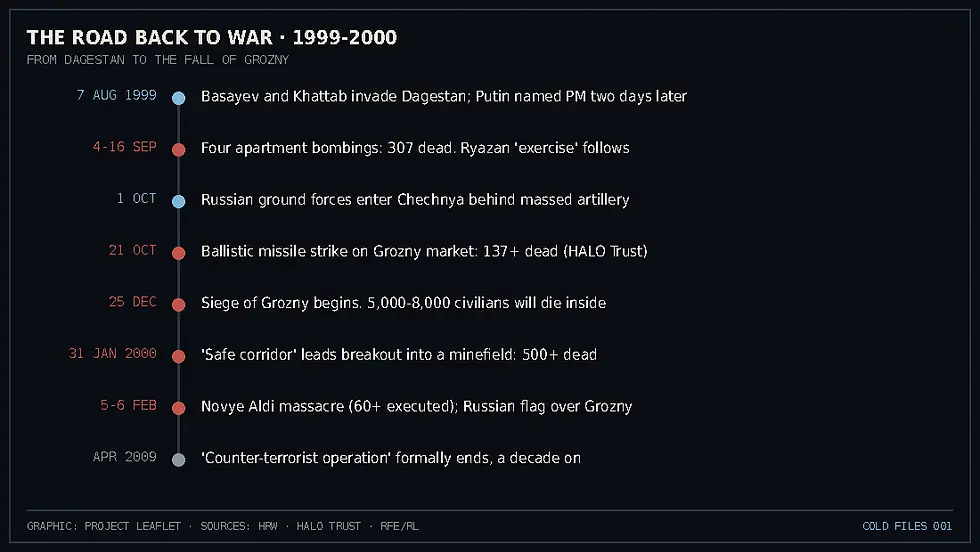
In August 1999, Basayev and Khattab led up to 2,000 fighters into neighboring Dagestan, declaring an Islamic state and expecting a local uprising that never came. Russia had its casus belli, and a brand-new prime minister to prosecute it: a former FSB director named Vladimir Putin, appointed on 9 August, unknown to most of the country.
Then the apartment buildings started coming down. Buynaksk on 4 September, 64 dead. Moscow, Guryanova Street, 9 September, 106 dead. Moscow, Kashirskoye Highway, 13 September, 119 dead. Volgodonsk, 16 September, 17 dead. In all, 307 people killed in their sleep, more than 1,700 injured. Moscow blamed Chechen-linked militants. The Chechen leadership denied it.
Then came Ryazan. On 22 September, residents of an apartment block found men planting sacks in the basement, wired to a detonator timed for 5:30 in the morning. Local police tested the contents and reported RDX, a military explosive. The men who planted them, when caught, produced FSB identification and were released on orders from Moscow. The FSB then announced the whole thing had been a training exercise, and the sacks only sugar. No independent examination was ever permitted. Alexander Litvinenko, the FSB officer who spent years publicly arguing his own service had done it, was poisoned with polonium in London in 2006; a British inquiry later found the operation was probably approved by Putin personally.
Cold Files does not claim to know who bombed those buildings. What is documented is this: the bombings turned a police operation into a holy war, Putin's approval went vertical on the promise to "wipe out the terrorists in the outhouse," and within six months he was president.
This time from a distance
The generals had spent five years studying New Year's Eve 1994, and the lesson they drew was not restraint. It was distance. This time there would be no columns of conscripts feeling their way into ambushes. Russian forces crossed into Chechnya on 1 October 1999 and advanced behind a rolling wall of artillery and airpower, flattening whatever was in front of them before infantry ever arrived.
On 21 October 1999, ballistic missiles with cluster warheads struck central Grozny at evening rush. The impacts hit the city's main market, a maternity hospital, and a mosque. The HALO Trust counted at least 137 dead on the day; Chechen officials later said over 280. Moscow's explanations shifted by the day: a clash between gangs, an ammunition dump, a terrorist accident. The missiles were Russian. Human Rights Watch, Memorial, and Amnesty International all documented the strike as an attack on a civilian target.
By December the city was encircled, roughly 3,000 fighters and tens of thousands of civilians inside, once again disproportionately the elderly and the poor, once again heavily ethnic Russian pensioners who had no mountain village to run to. Leaflets dropped in early December told everyone left to get out or be destroyed as a terrorist. The siege that followed, from 25 December 1999 to 6 February 2000, killed an estimated 5,000 to 8,000 civilians. The shelling did not distinguish a fighter from a grandmother in 1995, and it had not learned to by 2000.
The minefield
By late January the defenders were finished, and word reached them, through paid intermediaries, that a safe corridor out of the city ran southwest toward Alkhan-Kala. On the night of 31 January into 1 February 2000, the fighters took it. The corridor led into a minefield pre-registered by Russian artillery.
At least 500 fighters died in the breakout, with some counts running to 600. The mayor of Grozny, Lechi Dudayev, was killed. So were commanders Khunkar-Pasha Israpilov and Aslambek Ismailov. Shamil Basayev stepped on a mine, lost a foot, and was carried out. On 6 February the Russian flag went up over the wreckage, and Moscow declared the operation complete.
The day before the flag went up, riot police conducting a "mopping-up" swept the southern suburb of Novye Aldi. Human Rights Watch confirmed at least 60 civilians shot at close range, aged from a one-year-old boy to a woman of 82, alongside rapes, robbery, and the pulling of gold teeth. The units identified were OMON from St. Petersburg and Ryazan. Nobody was ever convicted. The village of Katyr-Yurt, packed with refugees and promised safe passage days earlier, was leveled with fuel-air bombs and Grad rockets; the European Court of Human Rights later ruled the operation an unlawful use of indiscriminate force against civilians, one of more than two hundred judgments Strasbourg would eventually issue against Russia over Chechnya. Russia paid the fines and changed nothing.
In 2003, with the war officially over, the United Nations called Grozny the most destroyed city on earth. Not in the Caucasus. On earth.
The dirty peace
What followed the fall of the city was not peace but management. Filtration camps, Chernokozovo the most notorious, processed thousands of Chechen men through beatings, torture, and ransom. The zachistka sweeps that produced Samashki in 1995 and Novye Aldi in 2000 became routine administration. Amnesty International documented up to 25,000 civilians killed in the second war and around 5,000 disappeared, many into unmarked graves that are still being found.
Moscow's exit strategy was to make the war Chechen-on-Chechen. Akhmad Kadyrov, the separatist mufti who had once declared jihad against Russia, switched sides and was appointed to run the republic in 2000. A bomb under a stadium VIP stand killed him on Victory Day 2004. His son Ramzan, then commanding a militia known as the kadyrovtsy, inherited the machine, became president in 2007, and turned Chechnya into a personal fiefdom that answers to the Kremlin in loyalty and to no one in law. The insurgency bled outward into Nord-Ost, Beslan, and a decade of North Caucasus violence. Russia formally ended its "counter-terrorist operation" on 16 April 2009, nine and a half years after it began.
Grozny was rebuilt with federal money into a showcase of towers and the largest mosque in Europe, which is its own kind of erasure. A city cannot testify once it has been repaved.
The ledger

Nobody counted the dead of the Chechen wars, which is part of the point. The ranges are the story. Academic estimates put civilian deaths across both wars at 150,000 to 200,000, a figure the pro-Moscow Chechen government itself has exceeded, claiming about 300,000 dead and 200,000 missing. Amnesty's second-war floor is 25,000 civilians; Memorial's combined estimates ran past 200,000. Russia officially admitted around 3,400 soldiers killed in the second war; the Union of Soldiers' Mothers put the true figure at roughly 11,000 by 2003, and independent analysts landed in between. Chechnya's pre-war population was about one million. Take even the middle of the civilian ranges, add the disappeared, and you arrive at the arithmetic: something like one in four or one in five of a nation dead, missing, or scattered inside a decade.
And the world's attention moved on almost immediately, for the same two reasons it never arrived. The state doing it held a permanent seat on the UN Security Council and a veto over any consequence. And the people it was done to had no satellites, no diaspora media machine, no infrastructure to make anyone watch. Grozny 1995 and 2000 were the rehearsal space for the playbook the world would finally learn to recognize in Aleppo and Mariupol: encircle, ultimatum, flatten, deny, rebuild, rename.
The file stays open. That is what this series is for.
Cold Files publishes deep reads like this once or twice a week alongside The Daily Sitrep. Part 1 covered the First War. Subscribe below to get the next file when it drops.
Sources consulted: Human Rights Watch, "February 5: A Day of Slaughter in Novye Aldi" (June 2000) and Chechnya war-crimes reporting 1999-2002; Amnesty International, "What justice for Chechnya's disappeared?" (2007); Memorial Human Rights Center casualty documentation; HALO Trust counts of the 21 October 1999 Grozny missile strike; European Court of Human Rights, Isayeva v. Russia and related judgments; RFE/RL reporting on the 1999 apartment bombings and the Ryazan incident; UN 2003 assessment of Grozny; standard references on the Battle of Grozny 1999-2000, the Dagestan incursion, Novye Aldi, Katyr-Yurt, and casualty estimates of both wars. Framing credit: @polishzach.
Read next: Cold Files 001: The First Chechen War, Part 1. The City That Ate an Army and Cold Files 003: The Battle That Was Deleted. Rzhev, 1942-1943.
Want the recap in your inbox? The channel sends one Sitrep Digest email on the 1st of each month, the best of the morning briefs in a five minute read. Drop your email in the subscribe box at the bottom of this page.


Comments