


Halabja Chemical Attack: The One Inference That Outlived the Evidence (Cold Files 016)

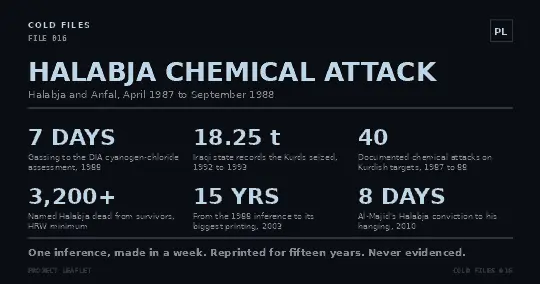
On 16 March 1988 Iraqi aircraft dropped chemical munitions on a Kurdish town. Within seven days the United States government had produced an assessment suggesting that Iranian gas killed most of the dead. The assessment rested on one inference about one chemical agent. No public evidence was ever added. It was printed in 1990 under the imprint of the United States Army War College, and printed again in the New York Times in January 2003, fifteen years later, by one of the men who wrote the monograph. This file is about how an attribution gets made, who keeps it alive, and what it takes to close one.
Part of the Cold Files series.
The week that decided everything
Iranian shelling of Halabja began on 13 March 1988, under an operation Tehran called Zafar 7 and described as a joint effort with Kurdish fighters of the Patriotic Union of Kurdistan. By the night of 15 March Iranian Revolutionary Guards were openly parading in the town. Human Rights Watch, which interviewed survivors at length, fixes no capture date and says of the rival Iranian and Kurdish accounts that "neither version can be regarded as wholly reliable."
The Iraqi counterattack began mid morning on 16 March with aircraft and artillery. One survivor said of a bomb that "it was different from the other bombs." Raids went on for hours. Around three in the afternoon, people sheltering in cellars noticed a smell they compared to sweet apples, to perfume, to cucumbers. One called it snake poison.
Seven days later, on 23 March 1988, the Defense Intelligence Agency issued an assessment attributing most of the Halabja deaths to cyanogen chloride, a blood agent it said Iraq had never used and in which Iran had shown interest. The same document attributed the mustard casualties to Iraqi weapons. That day State Department spokesman Charles Redman said Iraq appeared to have used chemical weapons and that there were "indications that Iran may also have used chemical artillery shells." No details were given.
Baghdad said the same within a fortnight. Everything downstream is that inference, recycled.

Published under an Army imprint
The both sides reading did not stay in an intelligence summary. Security Council Resolution 620 of August 1988 condemned chemical weapons use in the conflict without naming who had used it, and Joost Hiltermann, who led Human Rights Watch's work on the Kurdish campaign, argues the intelligence confusion delayed the Council two months and left it condemning both sides.
In 1990 the Strategic Studies Institute at the US Army War College published a monograph by Stephen C. Pelletiere, Douglas V. Johnson II and Leif R. Rosenberger titled Iraqi Power and U.S. Security in the Middle East. It records that the Kurds at Halabja were bombarded with chemical weapons producing a great many deaths, says Iraq was blamed even though Iran had used chemicals in the same operation, and concludes that "it seemed likely that it was the Iranian bombardment that had actually killed the Kurds." Pelletiere had been, according to Reason magazine, the CIA's senior political analyst on Iraq during the Iran Iraq war.
The monograph hedges. Two of its authors did not. Writing to the New York Review of Books in November 1990, Pelletiere and Johnson put their names and their institution to the stronger version: "All accounts of this incident agree that the victims' mouths and extremities were blue... Iraq never used blood agents throughout the war; Iran did. The U.S. State Department said at the time of the Hallabjah attack that both Iran and Iraq had used gas in this instance. Hence, we concluded it was the Iranians' gas that killed the Kurds."
Here is the strongest version of the other side. In 1988 Halabja had no forensics at all, and the public case rested on testimony. The Senate Foreign Relations Committee staff report of October 1988 by Peter Galbraith and Christopher Van Hollen concerned the August attacks, not Halabja, and it called its own refugee testimony "overwhelming evidence that Iraq dropped chemical weapons on its Kurdish population." Where it conceded that "the evidence available in Turkey is limited," the reason it gave was that only the lightly injured could cross the mountains.
A careful reader in 1988 could demand better proof, and the monograph did. By 1990 the demand was stale, and by 2003 it was something else. On 31 January 2003 Pelletiere published an opinion piece in the New York Times arguing that the gassing "came about in the course of a battle between Iraqis and Iranians" and that "we cannot say with any certainty that Iraqi chemical weapons killed the Kurds." Hiltermann's answer, written in 2008, closes the account: Pelletiere "has never presented any evidence in addition to the vague speculations made by the DIA at the time." Pelletiere later said a classified 1991 Army study he led covered Halabja in detail. It has never been published.
What closed it
Two things closed it, and neither was an argument.
The first was paper. During the uprising that followed the 1991 Gulf War, Kurdish parties seized the archives of the Iraqi security services and the Ba'ath party in the north and shipped them out in 1992 and 1993 under an arrangement with Middle East Watch and the Senate Foreign Relations Committee. Human Rights Watch put the total at 18.25 metric tons, roughly four million pages, of which about forty percent had been read and catalogued by December 1993.
What the regime had written about itself was worse than what anyone had alleged. Directive SF/4008, issued over Ali Hassan al Majid's signature on 20 June 1987, declared swathes of Kurdistan prohibited areas where all human existence was banned. One clause orders "random bombardments using artillery, helicopters and aircraft, at all times of the day or night" in order "to kill the largest number of persons present in these prohibited zones." Another orders that captured villagers be interrogated by the security services and that "those between the ages of 15 and 70 shall be executed after any useful information has been obtained from them." Later memos invoked the order euphemistically, as "the necessary measures," which tells you how it was being read.
On Halabja the documents are negative evidence of a usable kind. An Iraqi intelligence telex of 11 April 1988 refers to "the Iraqi chemical attack on Halabja," and a letter of 27 March 1988 refers to the bombing euphemistically. No captured record mentions Iranian gas at Halabja.

The second thing was dirt. On 10 June 1992 a forensic team assembled by Physicians for Human Rights and Middle East Watch, including the forensic anthropologist Clyde Snow, took samples from four bomb craters outside Birjinni, a village of about thirty houses in the Zawita subdistrict gassed at breakfast time on 25 August 1988, killing four members of one family. Analysis at the Chemical and Biological Defence Establishment at Porton Down found mustard agent and thiodiglycol in the first samples, and in the second set methylphosphonic acid and isopropyl methylphosphonic acid, degradation products of sarin. The result was announced in late April 1993. The analysts' own wording is the careful one: this was "the first time that we have found evidence in soil samples of traces of the degradation products of nerve agent."
Halabja's only published soil study sampled in 2016 and found nothing conclusive.
That leaves whether Iran could have done it. The chemical weapons historian Jean Pascal Zanders notes that as of 1984 Iran was not believed to have a chemical warfare capability. On that basis the Iran thesis requires Tehran building a sophisticated one in four years and pushing stocks forward with delegated release authority. He finds "hardly any evidence in the public record" that Iran assimilated gas into its doctrine, and the thesis "suffers from several internal inconsistencies and is difficult to support in the absence of concrete public evidence."
The famous one was not the only one
Halabja is an outlier in attention, not in kind. Human Rights Watch documented at least forty chemical attacks on Kurdish targets across the sixteen months from April 1987, and recorded that at least sixty villages plus the town of Halabja were hit with mustard gas, nerve gas or both. It cautioned that the real number is higher, because its table includes only what it could corroborate through eyewitness testimony.
Nor was the famous one ever properly counted. Halabja is remembered as five thousand dead, but that is the top of a range. Human Rights Watch put the toll "certainly in excess of 3,200," a count of individual names collected from survivors by the Kurdish researcher Shorsh Resool, and it remains the fullest register of named Halabja dead.

The earliest fully documented attack on Kurdish civilians came almost a year before Halabja. On the drizzly late afternoon of 16 April 1987, around a dozen aircraft bombed Balisan and Sheikh Wasan, two villages in a valley south of Rawanduz, as families prepared dinner. Human Rights Watch counted 24 dead at Balisan and 103 at Sheikh Wasan from direct exposure, 33 of them children under four. Survivors reached hospital in Erbil the next morning, where security officers ordered their treatment stopped and had them removed to a detention centre, and between 64 and 142 of them died there of untreated injuries and neglect. Its total for the valley is "at least 225, and perhaps as many as 400." Its framing is worth quoting exactly: "Until this moment no government had ever used chemical weapons against its own civilian population."
Goktapa, gassed on 3 May 1988, cost between 154 and 300 lives. On the morning of 25 August 1988 about a dozen nearly simultaneous strikes hit a strip of Badinan roughly sixty miles wide and twenty deep, and between sixty-five and eighty thousand Kurds fled across the Turkish border.

And there is a categorical point most accounts miss. Human Rights Watch is explicit that Halabja, "while remaining the single greatest atrocity of the war against the Kurds," was not part of Anfal, the eight stage campaign that ran from 23 February to 6 September 1988. Anfal was built for the rural population, Halabja was a city, and its survivors were not sent to the Anfal camps. Halabja falls inside the calendar of the first Anfal operation and outside its design.
What the courts settled, and what they did not
The legal record on attribution is unambiguous. The legal record on characterisation is not.
On 23 December 2005 the District Court of The Hague convicted Frans van Anraat, a Dutch businessman, Iraq's sole thiodiglycol supplier after 1984, of complicity in war crimes and sentenced him to fifteen years. It acquitted him of complicity in genocide because he had not been shown to know what his deliveries would be used for, while finding the attacks themselves genocidal: the court found them aimed at destroying Iraq's Kurdish population. The Court of Appeal raised his sentence to seventeen years in May 2007 and then went further than the acquittal, holding there was insufficient evidence to establish that the gas attacks amounted to genocide at all. The Supreme Court upheld the conviction in June 2009 and cut six months for the length of proceedings.
In Baghdad the Iraqi High Tribunal convicted Ali Hassan al Majid of genocide, crimes against humanity and war crimes in the Anfal case on 24 June 2007 and sentenced him to hang. Halabja was tried separately, in a case opened in December 2008, and he was sentenced to death again over the gassing on 17 January 2010. It was his fourth death sentence. He was executed eight days later, on 25 January 2010.
No court or tribunal has found Iran responsible for Halabja. The claim lived its life in an intelligence assessment, a press briefing, Baghdad's denials, a monograph and an op-ed page.
The case for the other side is worth stating plainly, because it is not nothing. Halabja was a two sided battle in which Iranian forces held the town, the symptom evidence did include a cyanide signature, and the blue lips the letter rested on are also produced by nerve-agent asphyxia. Zanders, who rejects the Iran thesis, concedes Iraqi weaponisation of hydrogen cyanide cannot be clearly demonstrated either, so the cyanide indicts nobody. The uncertainty was real for about a year. The claim built on it ran for fifteen.
More Cold Files: Biafra, the forecast that became a count and Srebrenica, the word that was never resourced.
NEXT IN COLD FILES: Tigray, 2020 to 2022. A war fought under a communications blackout, and the estimates that filled the silence.
Sources consulted
Human Rights Watch, Genocide in Iraq: The Anfal Campaign Against the Kurds, 1993
Middle East Watch, Bureaucracy of Repression, 1994
Physicians for Human Rights and Human Rights Watch, Birjinni soil sample statement, April 1993
Pelletiere, Johnson and Rosenberger, Iraqi Power and U.S. Security in the Middle East, Strategic Studies Institute, 1990
Pelletiere and Johnson, letter, New York Review of Books, 22 November 1990
Pelletiere, A War Crime or an Act of War?, New York Times, 31 January 2003
Galbraith and Van Hollen, Chemical Weapons Use in Kurdistan, Senate staff report, 1988
Joost R. Hiltermann, A Poisonous Affair, Cambridge University Press, 2007
Hiltermann, Halabja: The Politics of Memory, International Crisis Group, 14 March 2008
Jean Pascal Zanders, Allegations of Iranian Use of Chemical Weapons: Halabja, The Trench
UN Security Council Resolution 620, 26 August 1988
Public Prosecutor v. Frans van Anraat, Dutch judgements, 2005 to 2009
Iraqi High Tribunal, Anfal judgement 2007 and Halabja judgement 2010
Simonis, Al-Manmi, Abbas and Schoeman, Remnant Environmental Impacts of the Chemical Bombing of Halabja, Iraqi Journal of Science, 2019
Cold Files runs alongside the Daily Sitrep. For the files as they land, and the day's intelligence picture, follow Project Leaflet on t.me/TheLeaflet.


Comments