


Kramatorsk Bus Stop Attack: The Glide Bomb That Killed 33, and Why the Fortress Belt Cannot Stop It

Updated: 4 days ago

In brief: A Russian glide munition struck a bus stop in Kramatorsk at about 10:00 on Thursday, October 8, killing at least 33 people and wounding 18 in one of the deadliest single strikes of this year. The channel breaks down the UMPB D-30SN that police say did it, and what the strike says about where the Donetsk front is heading.
Part of our Ukraine War Analysis coverage.
At about 10:00 on Thursday morning, two city buses were working a street in Kramatorsk, one of the last big Ukrainian-held cities in Donetsk Oblast. Then a single Russian munition came down on the bus stop. By afternoon authorities counted at least 33 dead and 18 wounded, one of the largest single attacks of this year per Reuters. This is what we know about the Kramatorsk bus stop attack, and the weapon behind it.
Related: Neptune Missile Strike on Borisoglebsk: Six Su-34 Bombers Hit, and Ukraine Ends the Refinery Pause.
The Kramatorsk Bus Stop Attack, Hour by Hour
Ukraine's National Police identified the weapon as a UMPB D-30SN guided glide bomb, per ArmyInform. President Volodymyr Zelensky's morning statement counted 12 dead at the bus stop. By early afternoon the count had nearly tripled: at least 33 killed and 18 wounded, per authorities cited by Reuters, as local prosecutors posted images of bodies and debris beside a burning bus.
Donetsk Oblast Governor Vadym Filashkin wrote on Telegram that "Russia comes to the Ukrainian land with death," and added the colder logic: a bus full of passengers is an attractive target, because one strike can kill many people at once. The City Council said there were absolutely no military targets at the site. Moscow did not immediately comment. Russia denies targeting civilians.
The response was immediate and telling. Filashkin ordered public transport halted in both Kramatorsk and Sloviansk, saying officials have no right to risk residents' lives. It was not even the first bus hit this month: an FPV drone struck one on October 2, injuring two, per the City Council. A city that stops running buses is a city whose people get harder to move, and harder to evacuate.
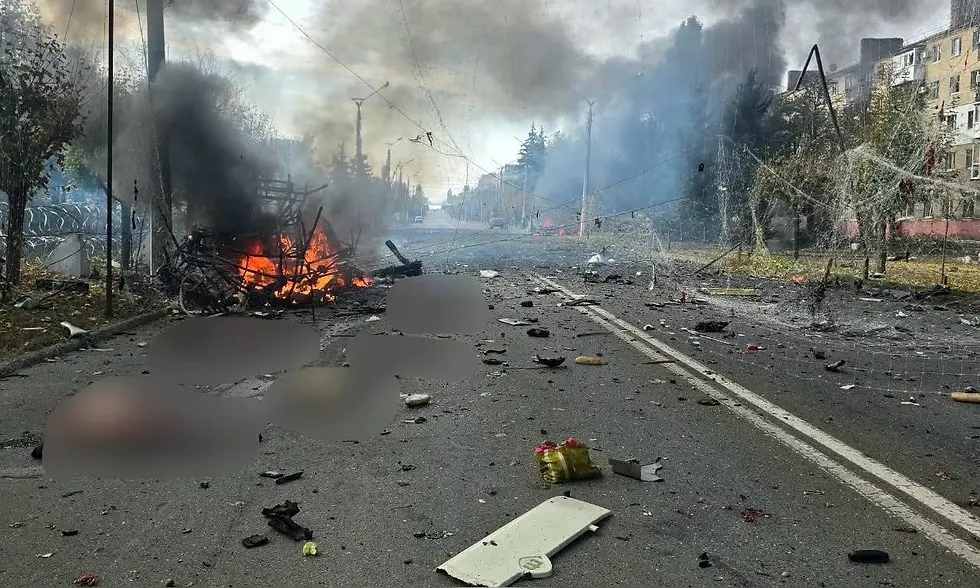
The strike site in Kramatorsk, October 8. Photo: ArmyInform, CC BY 4.0
What the UMPB D-30SN Actually Is
Unlike the UMPK, the strap-on wing kit Russia bolts to Soviet-era FAB bombs, the UMPB D-30SN is a purpose-built glide munition. Ukraine's intelligence agency HUR, in a September 2025 teardown, calls it the equivalent of a FAB-250 with the warhead integrated into the body, flying on satellite and inertial navigation with a Kometa-M8 adaptive antenna array built to work through Ukrainian jamming. Released by Su-34s and other tactical jets from 12 to 15 kilometers altitude, HUR puts its reach at up to 100 kilometers, with preliminary data suggesting it can also be ground-launched from Tornado-S rocket artillery.
That reach is the point. A bomb released from deep inside Russian-held airspace arrives outside the envelope of most of the air defense Ukraine can spare for Donetsk Oblast. The anti-drone netting that now covers Kramatorsk's roads works against FPV drones; it does nothing against a 250-kilogram-class glide bomb. And the family keeps evolving: in February, Ukrainian analysts reported a modernized UMPB-5 adding roughly 40 to 50 kilometers of range, plus a claimed turbojet UMPB-5R variant, unverified, that could theoretically reach 200 kilometers, per RBC-Ukraine.
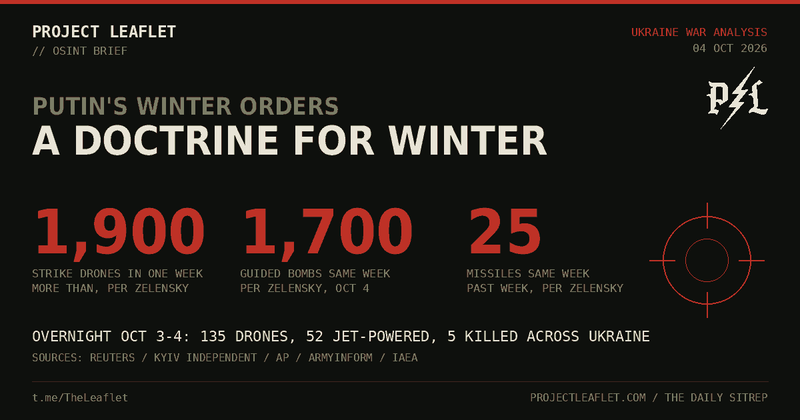
Volume is the other half of the problem. Zelensky's weekly tallies have been running at around 1,700 guided bombs per week this autumn, and January set a monthly record of more than 5,700 glide bombs dropped, per Euromaidan Press. HUR maps the UMPB's production web alone at 36 enterprises. Dozens are sanctioned. Some component suppliers still are not.

What a glide bomb leaves behind: destruction at the strike site in Kramatorsk. Photo: ArmyInform, CC BY 4.0
The Fortress Belt Is Emptying
Kramatorsk anchors the northern end of the fortress belt, the Sloviansk, Kramatorsk, Druzhkivka and Kostiantynivka chain that has been the backbone of Ukraine's Donetsk defense since 2014. Russian troops are a little over 10 kilometers away, per Kyiv Independent reporting from the city in August, which found glide bomb strikes scaling up and increasingly arriving in daytime, with Russian drones already operating over the eastern districts per analyst Michael Kofman.
The people are leaving, but slowly. As of a mid-August briefing by the Donetsk regional administration's Dmytro Petlin, about 42,300 civilians remained in the Kramatorsk community and 36,000 more around Sloviansk. On Thursday alone, Filashkin reported 31 shellings across the oblast and 256 people evacuated, 32 of them children.
The line itself is holding, for now. Ukraine's General Staff logged 224 combat engagements in the past day, 24 of them on the Kostiantynivka axis, per its October 8 report via ArmyInform. The same morning, Vladyslav Datsenko, a drone unit commander in the 67th Mechanized Brigade, said Russia is shifting unmanned systems units and GRU special forces to the Kramatorsk axis to set up a push on the Sloviansk agglomeration, while calling the situation there still relatively stable. Moscow's demand has not changed: it wants the rest of Donetsk Oblast ceded before it stops fighting, a goal its strikes now serve directly under Putin's new strike doctrine for the winter. On Thursday, US Secretary of State Marco Rubio told Kathimerini that "there appears to be no prospect of a negotiated settlement," a day after Russia's Sergey Ryabkov said there are no plans for talks in the US-mediated format.

Ukrainian infantry holding defensive positions in the east. Photo: ArmyInform, CC BY 4.0
The Same Morning, Everywhere Else
Kramatorsk was the worst of Thursday, not the whole of it. Overnight Russia launched 142 Shahed-type drones, 82 jet-powered, with 126 downed or suppressed, per Ukraine's Air Force. In Kyiv, which opened the winter grid war under the Zircon missile attack on Kyiv in late September, the city military administration reported 4 killed and 21 injured overnight, and Mayor Vitali Klitschko reported 3 killed in morning strikes. DTEK announced emergency power shutdowns in four Kyiv Oblast districts, and the city warned of water pressure problems on the right bank. In Pryluky, the toll from Wednesday's missile strike on an apartment block rose to 22, including 5 children, per Chernihiv Governor Vyacheslav Chaus.
Ukraine's long-range answer did not pause either. The General Staff confirmed a strike on the Gazprom Neftekhim Salavat refinery in Bashkortostan, roughly 1,300 kilometers from the front, extending the campaign we tracked in the Perm refinery drone strike, and a drone set fire to a Yandex data center in Sasovo, Ryazan Oblast, per Yandex's confirmation to AFP.
Why It Matters
The glide bomb is the cheapest standoff weapon Russia mass-produces, and it is doing to Donetsk what missiles do to Kyiv: making the cost of staying unbearable while the air defense that could stop it is needed elsewhere. A bus stop at mid-morning is where a city's remaining life concentrates, and the strike forced exactly the dilemma it was built to force: halting transport protects the roughly 78,000 civilians still in the two communities, and it also strangles ordinary life and evacuation. Russia has not been able to take these cities at current rates, so it is working to empty them.
What to Watch
Watch the Washington track first: Zelensky said negotiators will be in the US on Friday and Saturday to press for more pressure on Moscow, per ABC News. Watch whether the transport halt in Kramatorsk and Sloviansk hardens into a push for full evacuation, and whether daily evacuation numbers jump past the current few hundred. And watch the bomb itself: if turbojet UMPB variants start landing meaningfully deeper than 100 kilometers, the glide bomb stops being a fortress belt problem and becomes a Dnipro and Kharkiv problem, at a scale interceptors are not ready for.
The channel will be tracking all of it, daily, at t.me/TheLeaflet.
Read next: Putin's New Strike Doctrine: Winter Orders Against Civilians, and Zelensky's Refinery Answer and Zircon Missile Attack on Kyiv: Russia Opens the Winter Grid War With Hypersonics and Jet Drones.
Want this level of analysis in your inbox? Drop your email in the subscribe box at the bottom of this page and the channel will send you the Sitrep Digest: the best of these briefs in a five minute read.
Should Ukraine order a full evacuation of Kramatorsk and Sloviansk now, or does that hand Russia the emptied fortress belt it wants? Drop your take in the comments, or tell the channel what to cover next.
Sources
Kyiv Independent (Oct 8, 2026 and Aug 26, 2026), Reuters via The Moscow Times (Oct 8, 2026), ABC News/AP (Oct 8, 2026), Al Jazeera (Oct 8, 2026), ArmyInform (Oct 8, 2026), National Police of Ukraine via ArmyInform (Oct 8, 2026), HUR via Mezha (Sep 22, 2025), RBC-Ukraine (Feb 9, 2026), Euromaidan Press (Mar 11, 2026), Ukrinform (Aug 19, 2026). Photos: ArmyInform, CC BY 4.0.


Comments