


Putin's New Strike Doctrine: Winter Orders Against Civilians, and Zelensky's Refinery Answer

Updated: Oct 8
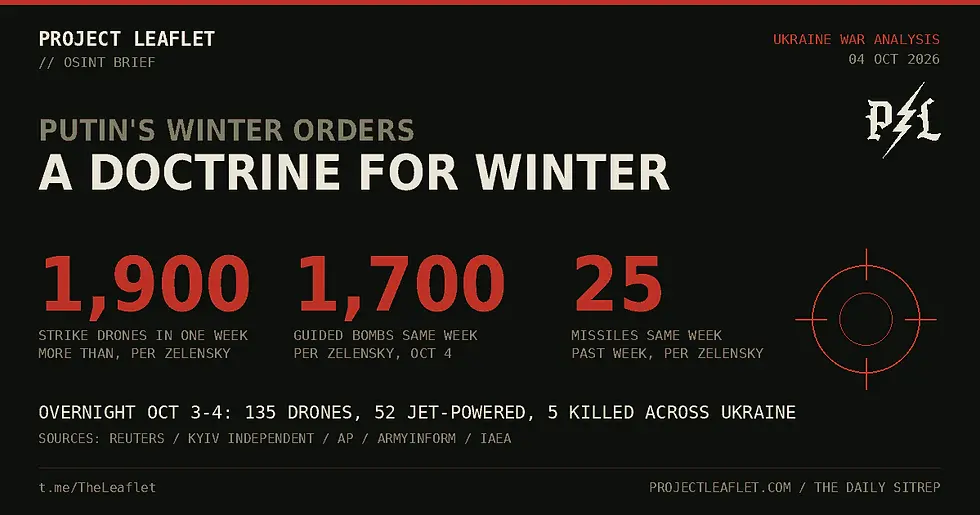
In brief: Ukrainian intelligence says it has seen documents in which Putin authorizes broader strikes on roads, schools and hospitals to push people out of Kyiv before winter. Zelensky's answer, delivered to Reuters on Saturday, October 3: Ukraine will go after the refineries that pay for the war, but not after Russian civilians.
Part of our Ukraine War Analysis coverage.
Putin's new strike doctrine is not a press release. It is, according to President Volodymyr Zelensky, a set of documents obtained by Ukrainian intelligence in which the Russian president authorizes his military to hit a far wider range of civilian targets ahead of winter. Zelensky described the papers in an interview with Reuters at the presidential offices on Saturday, October 3, air raid sirens sounding during the conversation. If the past week is the doctrine in action, the documents barely needed a leak.
The channel has been tracking the pieces all week: the Zircon missile attack on Kyiv that opened the winter grid war, the first deliberate attacks on the capital's Dnipro bridges of the war, and the transformers feeding Europe's largest nuclear plant being knocked out one by one. The doctrine is the thread that ties them together.
What Putin's New Strike Doctrine Allows
"We saw documents and we know that they allow them to attack infrastructure ... logistics ... roads, schools, hospitals," Zelensky told Reuters, adding that the goal is "to pressure people to leave the capital." In his reading, Putin needs a visible escalation to look strong while the front line gives him little: the president claimed Ukraine's Vivaldi counteroffensive near Lyman has retaken around 140 square kilometers, a figure the channel treats as a claim until the maps catch up.
Moscow is not exactly hiding the shift. Russia's Defense Ministry says Kyiv's bridges carry "troop movements and the logistics of military cargo deliveries," as reported by AP, and the Foreign Ministry promised continued "mass retaliatory strikes." When a capital's commuter bridges become declared military targets, the distinction between infrastructure and daily life is doing a lot of work.

Aftermath of the Russian attack on Kyiv at a residential high-rise, night of October 1 to 2. Photo: ArmyInform, CC BY 4.0
A Week That Reads Like the Orders
Zelensky's tally for the past week, posted on Sunday, October 4: more than 1,900 strike drones, around 800 of them jet-powered, 1,700 guided bombs, and 25 missiles. Ordinary residential buildings and critical infrastructure, he said, were the main targets.
Overnight into Sunday, Russia sent another 135 attack drones, 52 of them jet-powered. Ukraine's Air Force reported 125 targets intercepted, including two Banderol loitering munitions, but what got through killed at least 5 people and injured 30 across the country by Sunday afternoon, per the Kyiv Independent. In Sumy Oblast, a drone strike on a medical supply warehouse killed a 52-year-old employee, and guided bombs on the regional capital on Sunday morning injured at least seven more people, including a child, according to regional police.
And for the fourth consecutive day, Kyiv's crossings took hits: the Northern Bridge was struck again on Sunday morning, extending the Thursday-to-Saturday sequence we broke down in our Kyiv bridge strikes analysis.

Damage to a residential building in Sumy after Russian guided bomb strikes on Sunday morning, October 4. Photo: Sumy Oblast Police via ArmyInform, CC BY 4.0
The Zaporizhzhia Wild Card
The quietest line in this escalation may be the most dangerous. The IAEA confirmed that drone strikes on September 19, 20 and 27 damaged transformers at the Zaporizhzhia Thermal Power Plant's switchyard, equipment the agency calls vital to keeping off-site power flowing to the Russian-held Zaporizhzhia Nuclear Power Plant. A radiation monitoring station was disabled in a separate September 22 attack. The agency did not say who flew the drones.
IAEA chief Rafael Grossi is now negotiating what would be the eighth localized ceasefire around the plant's power lines, this one to allow repairs. Europe's largest nuclear plant heading into winter on a degraded grid connection, while both sides escalate their energy campaigns, is exactly the kind of risk that does not care about anyone's doctrine.

The Zaporizhzhia Nuclear Power Plant in Enerhodar. Photo: Ralf1969, Wikimedia Commons, CC BY-SA 3.0
Zelensky's Refinery Answer
"With their attacks on our energy, we have to respond on their energy. First of all, oil refineries: what gives money to them for this war," Zelensky told Reuters. He drew one line: "But we will not respond, of course, just like them, on any civilian objects."
The tools for that answer keep arriving. Zelensky confirmed the first combat launch of the FP-7 ballistic missile on October 1 and said the longer-range FP-9 should be ready this autumn. The model is already visible in the Perm refinery drone strike, which reached 1,500 kilometers into the Urals in late September. Expect the refinery list to get longer, not shorter.
Why It Matters
Doctrines formalize what the artillery already knows, and that is the point: if the documents are what Kyiv says they are, the winter campaign against civilians is policy, not excess. That matters for war crimes files, for Europe's planning on backup power and refugee flows, and for Washington's calculus on air defense deliveries. It also locks both sides into an energy war of attrition in which Moscow bets on Ukrainian morale breaking before Russian refining margins do.
What to Watch
Whether Kyiv publishes the documents or shares them with partners; whether bridge strikes spread beyond the capital's crossings; whether Grossi's repair ceasefire at Zaporizhzhia holds; and how fast the FP-9 moves from announcement to launch footage. Watch Ukrenergo's outage reports too: the grid numbers, not the press statements, will say whether the doctrine is working.
The channel tracks this escalation strike by strike, every day, at t.me/TheLeaflet.
Read next: The Energy Ceasefire Gambit: Zelensky and Trump Talk Truce While Both Grids Burn and Putin's Army Expansion: A Fourth Decree, 10,000 North Koreans, and a 27 Percent War Budget.
Want this level of analysis in your inbox? Drop your email in the subscribe box at the bottom of this page and the channel will send you the Sitrep Digest: the best of these briefs in a five minute read.
If Ukraine's answer is refineries, what is the ceiling: how deep into Russia's fuel system can Kyiv realistically reach this winter? Drop your take in the comments, or tell the channel what to cover next.
Sources
Reuters, Zelensky interview (Oct 3, 2026); The Moscow Times, carrying Reuters (Oct 3, 2026); Kyiv Independent (Oct 3 and Oct 4, 2026); AP (Oct 3, 2026); Kyiv Post (Oct 3, 2026); ArmyInform (Oct 4, 2026); IAEA statement via Kyiv Independent (Oct 3, 2026). Photos: ArmyInform, CC BY 4.0; Sumy Oblast Police via ArmyInform, CC BY 4.0; Ralf1969, Wikimedia Commons, CC BY-SA 3.0.


Comments