


Oleshky Evacuation: The War's Longest Ceasefire, and the Road Home Through Russia and Belarus


Hundreds of civilians evacuated from Russian-occupied Oleshky crossed into Ukraine's Chernihiv region on Saturday, Oct 31, under a localized ceasefire brokered by US First Lady Melania Trump, the longest silence regime of the full-scale war by Kyiv's count. The truce behind the Oleshky evacuation expires at 22:59 Kyiv time tonight, having held while the wider war burned on around it.
Part of our Ukraine War Analysis coverage.
The Oleshky evacuation ended the only way the geography of this war allows: the long way around. Civilians who had spent nearly five years under occupation, directly across the Dnipro from Ukrainian-held Kherson, came home by bus through occupied Crimea to the Russian port city of Anapa, by charter flight to Gomel in Belarus, and finally by coach across the border into Chernihiv Oblast on Saturday.
A trip that takes minutes in peacetime took three countries, two days, and the personal intervention of the US First Lady. The channel has tracked ceasefire diplomacy all autumn, from the Oslo peace talks to the Witkoff Putin meeting at the Kremlin, and Oleshky is the outlier: the narrow, verifiable truce held, while every grand framework so far has not.
A Town That Was Starving
Oleshky sits on the left bank of the Dnipro and has been occupied since the first days of the full-scale invasion. Around 24,000 people lived there before the war. By late September, Ukrainian officials put the remaining population near 2,000, after the Kakhovka dam collapse flooded the town in June 2023 and a Russian blockade slowly strangled what was left. The UN Human Rights Monitoring Mission recorded the last known food delivery on May 26, and the last grocery store stopped normal operation back in January.
What kept people alive was improvised. Marines of Ukraine's 34th Brigade flew food and medicine across the river by heavy cargo drone, a few kilograms per sortie, on routes planned so Russian forces could not track the drop points, per ArmyInform. Driving out was close to suicide: the roads were mined and watched by drones. When volunteers tried a four-vehicle aid run on Sep 1, the lead car hit a mine and the convoy came under drone attack, volunteer Kseniia Arkhipova told the Vgoru outlet. One evacuee, identified as Valera, put the end state plainly, per Al Jazeera: 'People were cooking grass.'

Destruction in Oleshky, Kherson Oblast. Photo: ArmyInform, CC BY 4.0
Kyiv tried the front door first. Foreign Minister Andrii Sybiha raised Oleshky at the UN in September, and ombudsman Dmytro Lubinets said as late as Sep 26 that Russia had refused both a land corridor and a ceasefire. Then the back channel opened.
How the Melania Trump Ceasefire Was Brokered
On Oct 23, the White House announced a localized ceasefire for Oleshky and credited First Lady Melania Trump as the intermediary who, in its words, initiated discussions with both nations. Lubinets led the Ukrainian side; Russia's human rights commissioner Yana Lantratova led the other. Pope Leo XIV had pressed both capitals to allow aid and evacuations after Ukraine's Council of Churches appealed to him directly.
The terms, per Lubinets: a silence regime over the Oleshky sector, humanitarian cargo in, free exit for anyone who wants out. Ukraine's General Staff set the start at 3:00 a.m. Kyiv time on Tuesday, Oct 27, with the regime scheduled to run until 22:59 on Sunday, Nov 1.
Skepticism was earned. The energy ceasefire announced by President Trump on Oct 13 never took effect, with energy ceasefire violations logged within days, and ISW notes the Kremlin has rejected every broader ceasefire proposal since March 11, 2025. Stefan Vorontsov of the NGO Humanity warned the Kyiv Independent about provocations and propaganda risks. The difference this time was scope: one town, named negotiators, and a line on the map small enough to verify.
The Road Home Ran Through Three Countries
The first three days went to engineers. Demining teams cleared the designated routes around the municipal hospital while both sides held fire. On Friday, Oct 30, a joint delegation entered the town, and video released by Army Media showed residents embracing Lubinets, one woman calling the visitors 'ridnesenki nashi,' roughly 'our dear ones.' By then the ceasefire had held for 80 hours.
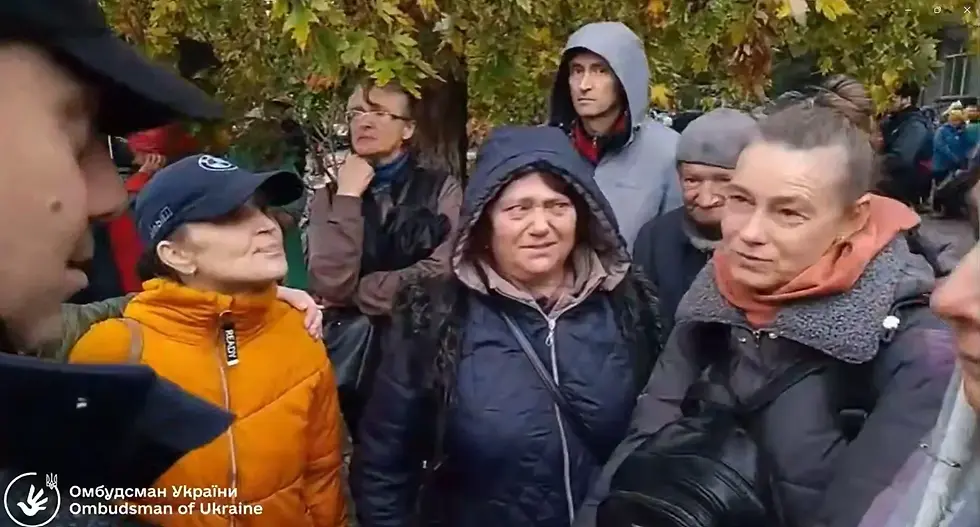
The Ukrainian delegation on the ground in Oleshky on Friday, Oct 30. Still from the Ombudsman's video via ArmyInform, CC BY 4.0
The convoy that rolled out that evening was 25 buses with 750 seats, plus ambulances for residents who could not board on their own. By Friday night, Lubinets reported 87 hours of ceasefire without a single recorded violation, and he has since called it the longest silence regime since 2022, per ArmyInform. Evacuees bound for Russia were taken to a reception center in Simferopol, in occupied Crimea, per Al Jazeera. Those coming home rode through Crimea to Anapa, boarded four charter flights to Gomel in Belarus, then crossed into Chernihiv Oblast by coach on Saturday.
How many came home is deliberately unclear. Kyiv restricted both the number and the crossing point to protect the roughly 2,000 civilians still in Oleshky and any future missions, per AP. Melania Trump said Friday the convoy could safely move more than 750 people; a Red Cross worker at the border said about 500 arrivals were expected, per Al Jazeera. At the crossing, relatives waited beside aid tents from the Red Cross, Doctors Without Borders and World Central Kitchen, and AP found Liza Paliy, 19, waiting for the father she had not seen in two and a half years.
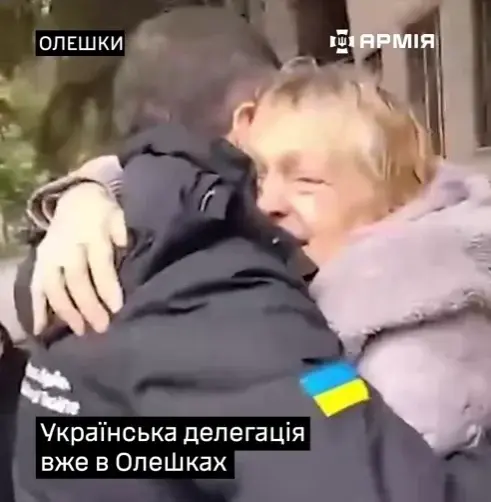
An Oleshky resident embraces ombudsman Dmytro Lubinets during the mission, Oct 30. Still from the Ombudsman's video via ArmyInform, CC BY 4.0
Zelensky thanked the US administration and Melania Trump by name and said all of the evacuees will receive the assistance they need.
The War Did Not Pause Around It
None of this stopped the war around the box. On the same Saturday, Russia's Defense Ministry claimed its air defenses downed 433 Ukrainian drones overnight, Zelensky said Russian strikes had cut power to some 280,000 households in the Dnipro and Kyiv regions, and a Ukrainian drone killed two people in Russia's Bryansk Oblast, per the region's governor. Days earlier, the Dnipro train station attack had killed 15 people on a passenger platform in daylight.
ISW logged strikes on a Kyiv combined heat and power plant and four substations in Dnipropetrovsk Oblast on the same days the Oleshky corridor ran. The guns went quiet in exactly one place, drawn around one town, for not quite six days.
Why It Matters
First, the mechanism is now proven. A ceasefire with narrow scope, named negotiators on both sides and a verifiable perimeter held for days with zero recorded violations, by Kyiv's count, while framework-level deals died on contact with the front. That is a checkable data point, not a vibe.
Second, there is appetite for a sequel. Lubinets has publicly proposed to Melania Trump that the operation continue, per ArmyInform, and the need is already mapped: up to 6,000 people, including more than 180 children, may require aid across Oleshky and nearby occupied settlements.
Third, the dark reading deserves its paragraph. Every evacuation also empties the town. Russia ends the week with fewer witnesses inside Oleshky and a humanitarian win for state TV, exactly the propaganda use the skeptics warned about. Whether this model saves people or launders occupation depends on what gets negotiated next. In our read, right now it does both.
What to Watch
The silence regime expires at 22:59 Kyiv time tonight. Watch whether it lapses, extends or gets replicated around another blockaded settlement, and whether the estimated 2,000 civilians who stayed keep receiving aid once the cameras leave.
Watch the diplomatic calendar too. Kremlin aide Yuri Ushakov has said new US-Russia contacts are possible in Abu Dhabi after Nov 4, per Meduza. And weigh one working truce against Secretary of State Marco Rubio's line at the G20 foreign ministers meeting, per the Kyiv Independent: 'I don't know if negotiated peace is achievable in Ukraine.' The space between that sentence and Oleshky is where the next month of this war lives.
The channel tracks this war every morning. For raw feeds and field notes as they land, follow t.me/TheLeaflet.
Read next: Oslo peace talks: Witkoff flies in with a deal on Russia's terms and Patriot missile sale to Ukraine: 500 PAC-3 interceptors approved.
Want this level of analysis in your inbox? Drop your email in the subscribe box at the bottom of this page and the channel will send you the Sitrep Digest: the best of these briefs in a five minute read.
If the Oleshky model gets a second run, where should it go next: another blockaded left-bank Kherson town, villages on the Zaporizhzhia line, or a prisoner-focused deal? Drop it in the comments or tell the channel what to cover next.
Sources
Kyiv Independent (Oct 23 and Oct 31, 2026), Kyiv Post (Nov 1, 2026), AP via CBS News (Oct 31, 2026), Al Jazeera (Oct 31, 2026), ArmyInform (Sep 30, Oct 28, Oct 30 and Oct 31, 2026), ISW (Oct 31, 2026), White House statement (Oct 23, 2026), Meduza (Oct 28, 2026). Photos: ArmyInform, CC BY 4.0.


Comments