


Russia's Land Corridor to Crimea: The Mius Bridge Strike, and the War That Is Now About Bridges

Updated: 5 days ago

In brief: Drones closed the Mius River bridge on Russia's R-280 highway to occupied Crimea on Sunday morning, November 8, a day after Russian ballistic missiles shut Kyiv's Northern Bridge in both directions. Both sides are now openly targeting each other's bridges, and the corridor that feeds Russia's southern occupation force is getting thinner by the month.
Part of our Ukraine War Analysis coverage.
Russia's land corridor to Crimea runs on a handful of bridges, and on Sunday morning, November 8, one of the most important of them went out of service. Rostov Oblast Governor Yuri Slyusar said a drone attack and falling debris damaged the deck of the bridge over the Mius River at the 97th kilometer of the R-280 highway in Neklinovsky district, along with two crawler cranes working on the span. By midday, the road leading to the crossing was closed.
No casualties were reported. What was reported, on both sides of the border, is a war that has entered a phase where the bridges themselves are the targets: the ones carrying Russian military cargo south toward Mariupol and Crimea, and the ones carrying Kyiv's commuters across the Dnipro.
Related: Crimean Bridge strike: 1,336 drones in one night, and the fourth attack on the Kerch crossing.
The bridge at kilometer 97
The Mius crossing sits about 155 kilometers from the front line, on the Russian side of the R-280, the highway Moscow calls Novorossiya. Slyusar said the same morning's drones also damaged a transformer at the Sulin power substation in the region's Millerovsky district, cutting electricity to multiple villages. A day earlier, occupation officials said drone strikes on the grid had left more than 300,000 customers in the south and center of occupied Luhansk Oblast without power, according to the Russian Telegram channel Astra via Euromaidan Press.
The Ukrainian monitoring channel Exilenova+ published footage it said showed the bridge being struck by an FP-2, the heavy strike variant in Fire Point's drone family. The Kyiv Independent could not verify that claim, and Kyiv has not commented on the attack. Russia's Defense Ministry claimed its air defenses downed 142 drones overnight, including over Rostov Oblast and Crimea.
The detail that gives the strike its weight is what Russia was doing to the bridge before it was hit. Moscow began widening the Mius crossing to four lanes in 2025, part of an upgrade of the R-280 into a hardened military artery, per Euromaidan Press. Ukraine just closed the bridge Russia was investing in.
Russia's land corridor to Crimea is getting shorter
Russia built the R-280 out from 2023 as an answer to a problem of its own making: the Crimean Bridge at Kerch was too exposed, so military cargo needed a land route. The highway runs from Rostov-on-Don along the Azov coast through occupied Mariupol, Berdiansk and Melitopol toward Dzhankoi and Simferopol, the backbone of the land corridor to the peninsula, per RFE/RL.
Ukraine has spent 2026 making that corridor unusable. The middle strike campaign, launched in the spring per the Kyiv Independent, put drones over the highway's occupied stretches and began hunting the trucks on it. By early June the results were public: Robert Brovdi, commander of Ukraine's Unmanned Systems Forces, said the command of Russia's Vostok group had banned military cargo on the Mariupol to Simferopol section from June 7, after traffic collapsed by 71 percent in two weeks, from roughly 3,800 trucks a day to about 1,100. "Traffic collapse is not a blockade," Brovdi said, per the Kyiv Independent, "but the current 'diet' imposed on this first land corridor, the lifeline of the occupation grouping, is sensitive and effective."
The squeeze has since moved from the trucks to the structures themselves. In early October, OSINT analysts reported the destruction of the Chonhar road bridge linking occupied Crimea with the occupied part of Kherson Oblast, per NV, and a substation strike produced the Crimea blackout that switched off the peninsula for a night in late October. Ukraine's defense minister said in June that the strikes are turning occupied Crimea into an island. The Mius bridge is the same logic applied at the corridor's northern end: when the trucks reroute, hit the road they reroute onto.
Kyiv's bridges are the mirror
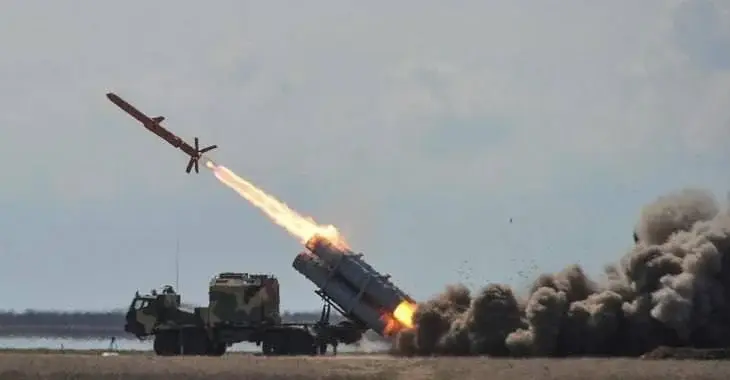
Photo: Neptune mobile missile system, file photo via ArmyInform, CC BY 4.0
Russia is running the same play in reverse. Overnight on November 6-7, waves of ballistic missiles damaged Kyiv's Northern Bridge over the Dnipro, closing it in both directions; Mayor Vitali Klitschko said the attack tore up the road surface, a trolleybus line and a power line. The Southern Bridge, whose metro span was hit in the Kyiv bridge strikes campaign that opened in October, had already pushed the city to approve backup river crossings. On November 8, President Volodymyr Zelensky tasked Prime Minister Serhii Koretskyi with building a free public transportation program for Kyiv, a wartime adaptation for a capital whose river crossings are now targets, per the Kyiv Independent.
None of it is accidental. "We currently have intelligence indicating that a new attack is being prepared against our energy infrastructure, our bridges across the Dnipro River, and civilian infrastructure," Zelensky warned in his evening address on November 6, two days before the Mius strike. He also said the quiet part: "Today I spoke with the team responsible for deep-strike operations, our long-range strikes." Then, plainly: "Russia will face our response."
The next 48 hours delivered it. Ukraine's General Staff said Neptune missiles hit the Proton-Electrotex plant in Oryol, which makes components for Iskander-M ballistic missiles and Kover cruise missiles, and Zelensky publicly thanked the Neptune crew for strikes on military production in Oryol and Rostov Oblast, per ArmyInform. The same night, drones set Rosneft's Saratov refinery on fire, per footage verified by Astra. Then the Mius bridge went down, the latest reach of the deep-strike campaign that reportedly put a thousand drones over St. Petersburg last month.
The overnight tape

Photo: rescue workers in Kremenchuk, November 9, State Emergency Service via ArmyInform, CC BY 4.0
The exchanges did not pause for the weekend. Russia attacked overnight into November 9 with 317 strike drones, 105 of them jet-powered, plus S8000 Banderol cruise missiles, Ukraine's Air Force said; by 8 a.m. it counted 271 drones and five Banderols shot down or suppressed. In Kremenchuk, strikes on a residential area and a local enterprise started fires at several locations and injured seven people, including a 16-year-old, with rescuers pulling 15 residents to safety, the State Emergency Service said. The Kyiv Independent counted 28 people injured across Ukraine over the past day as the grid campaign ground on, and the EU said it would activate an emergency mechanism to back Ukraine through the deepening energy crisis.

Still from a 208th Anti-Aircraft Missile Brigade video of a jet-powered Shahed shootdown over Mykolaiv Oblast, November 9, via ArmyInform, CC BY 4.0
Why it matters
Bridges are the war's most honest scoreboard. Russia needs the R-280's crossings intact to supply roughly a thousand kilometers of occupied coastline without leaning on the exposed Kerch bridge. Ukraine needs the Dnipro crossings intact to keep its capital functioning through a winter of blackouts and Ukraine's Patriot missile shortage. Each side has now decided the other's bridges are fair targets, and each hit forces expensive adaptations: Russia rerouting military cargo onto back roads under drone surveillance, Kyiv budgeting for backup crossings and free transit. The side that can keep its own spans standing while dropping the other's wins something more durable than a night's exchange of drones.
What to watch
The bridge duel sets the table for Abu Dhabi, where US-mediated talks open November 10-11, with Russia sending Deputy Foreign Minister Sergei Ryabkov to the table for the first time and Europe confirming its presence through French Foreign Minister Jean-Noel Barrot, per the Kyiv Independent. Watch whether Russia can reopen the Mius crossing quickly, whether Ukraine claims the strike and names the platform, and whether the next mass barrage goes after the Dnipro bridges Zelensky warned about. The channel will track all three on t.me/TheLeaflet.
Read next: Crimea Blackout: The Substation Strike That Switched Off a Peninsula and Operation Veles: Ukraine's 15 Kilometer Underground Strike at Kupiansk
Want this level of analysis in your inbox? Drop your email in the subscribe box at the bottom of this page and the channel will send you the Sitrep Digest: the best of these briefs in a five minute read.
Which crossing is the bigger single point of failure this winter: the Mius bridge feeding Russia's southern group, or Kyiv's Northern Bridge? Drop your read in the comments, or tell the channel what to cover next.
Sources
Kyiv Independent (Nov 6, 8 and 9, 2026), Euromaidan Press (Nov 8, 2026), Kyiv Post (Nov 8, 2026), NV (Nov 8, 2026), Censor.NET and Interfax-Ukraine (Jun 2026), ArmyInform (Nov 7 and 9, 2026), Ukrinform (Nov 9, 2026). Photos: ArmyInform, CC BY 4.0.


Comments