.png)


The ASC 890 Is Flying: Ukraine Confirms Six Months of Combat Missions for Its Swedish Radar Plane
- chris Naganuma
- 2 days ago
- 5 min read


For six months, Ukraine has been flying a NATO-standard early warning aircraft over its own airspace, and almost nobody said a word. This week the silence broke: Ukraine's Ministry of Defence confirmed that the ASC 890, the Swedish Saab 340 radar plane pledged back in 2024, has been flying combat missions since March. It is the quiet kind of announcement the channel likes best, because it is not about one strike or one night. It is about the architecture of the entire air war changing underneath everyone's feet.
The confirmation, reported by Militarnyi, Ukrainska Pravda and Defence Blog on September 4 and 5, ends a two-year saga that began as the headline item of Sweden's largest single aid package and nearly disappeared into the fog of integration work. It also lands in the middle of the heaviest sustained air campaign of the war, which is exactly the problem this aircraft exists to solve.
Two Years From Pledge to Battlespace
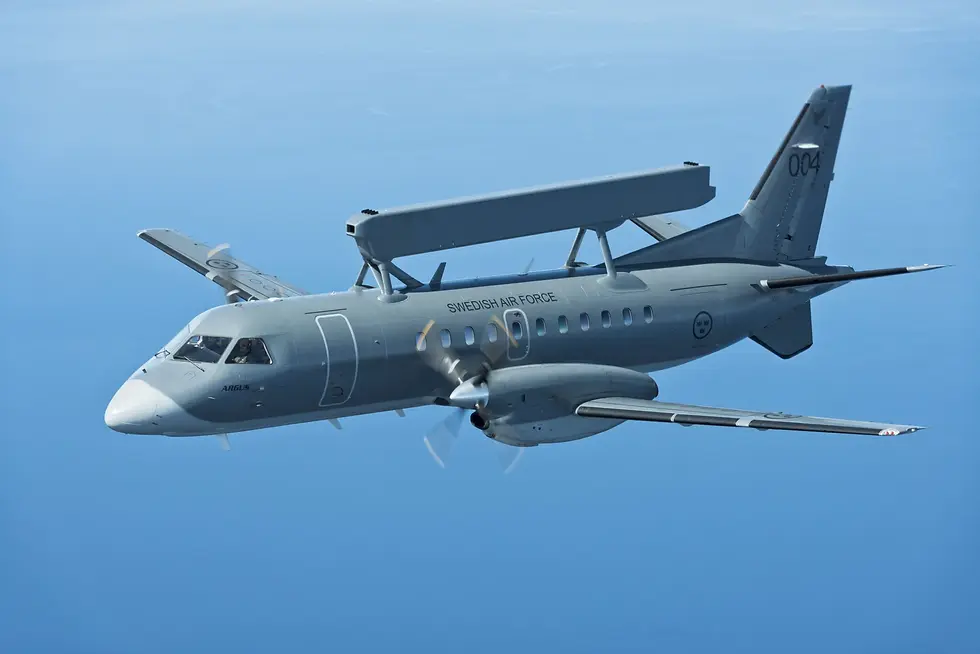
Photo: Ukraine's Ministry of Defence via ArmyInform, CC BY 4.0
The timeline tells you how hard this actually was. Sweden announced the transfer on May 30, 2024, giving up both of its own ASC 890s, the entirety of its national airborne early warning fleet, inside a package worth roughly 1.16 billion euros. Stockholm was not donating spares. It was donating its eyes, and accepting a capability gap at home until replacements arrive.
Then came the slow part. By March 2025, Swedish officials were tying delivery delays to the datalink problem: the aircraft's data-sharing systems had to be made to work with Ukraine's F-16s, and reporting by The War Zone noted that Link 16 connectivity on Ukrainian F-16s had earlier been removed or disabled over American capture concerns. The handover was confirmed in August 2025, with Prime Minister Ulf Kristersson formally passing the aircraft to Ukraine's ambassador, per Militarnyi. First footage of the distinctive radar bar over Ukraine surfaced on March 20 this year via OSINT channels, and the Ministry of Defence has now confirmed what that video hinted: combat sorties since March 2026.
What the ASC 890 Actually Sees
The Saab 340 airframe is a modest regional turboprop. The Erieye radar bolted to its spine is not modest at all. Per Militarnyi's breakdown, the FSR 890 Erieye is an S-band system with an instrumental range of 450 kilometers, fighter-sized target detection out to roughly 350 kilometers, altitude coverage up to 20 kilometers, and the capacity to track up to 1,000 air targets and 500 surface targets simultaneously.
The number that matters most is the low-altitude one. A ground radar is a prisoner of the horizon: against a cruise missile or drone hugging the terrain at low altitude, it may get 40 to 50 kilometers of warning. An Erieye cruising at 20,000 feet looks down instead of out, and Militarnyi reports it can pick up low-flying cruise missiles at several hundred kilometers. That is the difference between scrambling after a threat is already inside the defended zone and building an intercept plan while it is still crossing occupied territory.
The Ministry's own framing is the tell. Together with the F-16, Mirage 2000 and Gripen, the ministry said, the aircraft forms the foundation of a modern network-centric air combat system in accordance with NATO standards. Translated from procurement language: the radar plane sees, the datalink shares, and the fighters shoot targets their own noses never had to find.
Russia Lost Its Radar Planes. Ukraine Just Gained Two.

Photo: Ukrainian Air Force via ArmyInform, CC BY 4.0
There is a brutal symmetry here. In six weeks of early 2024, Ukraine shot down two of Russia's A-50 radar aircraft, one on January 14 over the Sea of Azov and one on February 23, a loss even Russian officials later acknowledged. The surviving A-50s have flown cautiously ever since, pushed back from the front lines, which degrades exactly the lookdown coverage Russia needs against Ukraine's low-flying cruise missiles and long-range drones.
Ukraine is now standing up the capability Russia has been losing. The caveats are real: two airframes cannot provide continuous coverage, the aircraft will likely orbit over western Ukraine to stay outside the reach of MiG-31s and long-range missiles, and Russia will hunt it, because both sides understand that a radar plane is worth more than a squadron of fighters. The War Zone's assessment is blunt on this point: with A-50s down, Ukrainian AEW aircraft become prime targets, and frequent relocation between airfields is part of the survival plan.
A Radar Plane for the Shahed Era

Photo: ArmyInform, CC BY 4.0
The confirmation did not land in a vacuum. It landed in a week when Russia's air campaign and a supposed pause are running side by side. While Witkoff and Kushner shuttle between Moscow and Kyiv with the capitals under a narrow no-strike understanding, the rest of the country is getting hit anyway. Overnight into September 5, per the Kyiv Independent, Russia launched 108 drones, of which Ukrainian defenders downed 82, plus 6 S8000 Banderol cruise missiles intercepted, and attacks killed at least 8 people and injured 69 across Kharkiv, Kherson, Zaporizhzhia and beyond. Ukraine's Armed Forces put it plainly, as carried by Militarnyi: a ceasefire cannot be unilateral or asymmetrical.
This is the target set the ASC 890 was built for. The past two weeks of this war have been defined by jet-powered Shaheds compressing reaction time and by cruise missiles routed around ground radar coverage. An airborne lookdown radar does not add a single interceptor to the stockpile, but it makes every existing interceptor smarter: earlier tracks, better cueing for F-16s flying drone-hunting sorties, and fewer Patriot radars forced to radiate, and reveal their positions, just to build a picture.
Why It Matters
Air defense in this war has always been arithmetic: so many launchers, so many missiles, so many minutes of warning. The ASC 890 attacks the arithmetic at its weakest term, warning time. And it is the leading edge of a bigger structure. Ukraine signed for up to 150 Gripen E fighters in October 2025, agreed this summer to buy the first 16, and Zelensky has said the Air Force should get its first Gripen C/D airframes at the beginning of 2027. Erieye was designed from birth to talk to Gripens. What entered combat in March is not one aircraft; it is the first working piece of a Nordic-built air force.
What to Watch
Watch for three things: any sign of the second airframe reaching operational status, which would stretch coverage windows toward something continuous; F-16 intercept claims at unusual ranges or in unusual sectors, the statistical fingerprint of AEW cueing; and Russian attempts to reach the orbits, whether with R-37M shots from MiG-31s or deep strikes against the airfields that host the plane. Sweden's own gap is worth a glance too: Stockholm gave away its only radar planes betting that Ukraine's sky is where they matter most. Six months of combat missions say the bet is being cashed.
The channel will keep tracking the air war daily on Telegram at t.me/TheLeaflet, and the deep reads land every morning here in The Daily Sitrep.
Read next: Zero for Twenty-Eight: The Night Kyiv's Air Defense Math Broke and Closing the Sky: Zelensky Puts Russian Aviation on Notice.
Want the recap in your inbox? The channel sends one Sitrep Digest email on the 1st of each month, the best of the morning briefs in a five minute read. Drop your email in the subscribe box at the bottom of this page.
Sources
Reporting and data: Militarnyi, Ukrainska Pravda, Defence Blog, The War Zone, United24 Media, Kyiv Independent, Kyiv Post, Euronews, The Defense Post. Capability figures per Ukraine's Ministry of Defence and Saab published specifications as carried by Militarnyi; intercept tallies per Ukraine's Air Force as carried by the outlets above. Photos: Ukraine's Ministry of Defence and Ukrainian Air Force via ArmyInform, CC BY 4.0.


Comments