


The Ukraine US Drone Deal Is Ready: Kyiv's Interceptors Already Defended American Bases From Iran

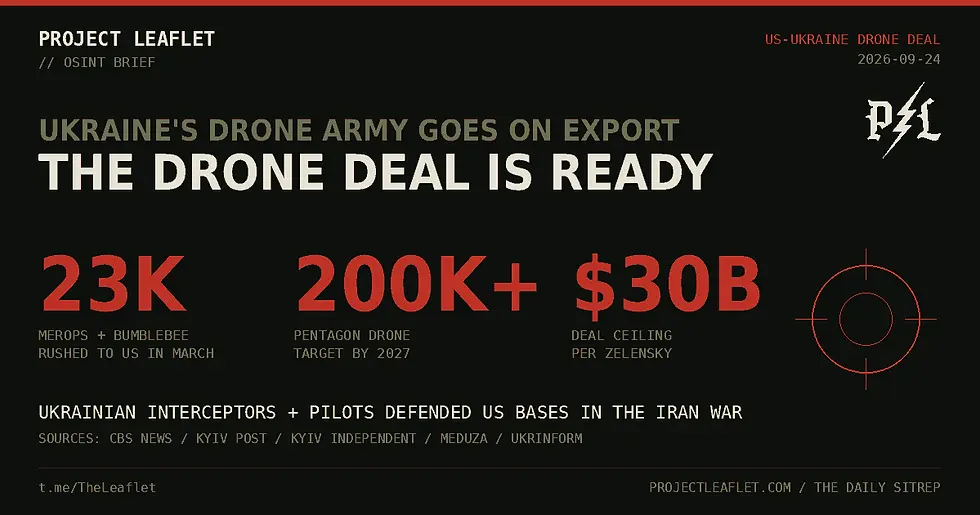
In March 2026, with Iranian Shaheds hunting American installations in the Middle East, the US Army asked Kyiv for 13,000 Merops interceptor drones and 10,000 Bumblebee strike and reconnaissance drones. Ukraine delivered them within days. According to CBS News, Ukrainian pilots came with them. That story stayed buried for six months, and it surfaced this week for a reason: the Ukraine US drone deal is finally written, and Zelensky arrived in New York ready to sign it.
What the Ukraine US drone deal actually covers

Photo: US Army, public domain
CBS News, citing three sources familiar with the matter, reported this week that Ukraine is prepared to sign a landmark drone defense agreement with the United States, and that Zelensky was ready to put his name on it during the UN General Assembly. The signing may still slip: the same sources say Washington wants to finalize only when it is ready to execute, and neither the White House nor the Pentagon has confirmed a date.
The structure matters more than the ceremony. Per Kyiv Post's read of the reporting, this is not a shopping list of contracts for a few chosen firms. It is a framework: leading Ukrainian defense companies working directly with American counterparts and the US military, expanded testing and production of Ukrainian technology on US soil, joint ventures, export permissions that cannot strip Ukraine's own front line, and protection for Ukrainian intellectual property. A first memorandum was drafted back in May. The names in the room are the names the channel has been tracking all year: Perennial Autonomy's Merops interceptor, SkyFall and Neros from the Pentagon's FPV competitions, Sine Engineering's AI beacons, Skyeton's Raybird.
The money frame has been public since July 2025, when Zelensky put the potential value of drone agreements with Washington at 10 to 30 billion dollars, a win-win construction in which America buys Ukrainian drones while Kyiv buys American weapons.
13,000 Merops in days: the Iran war chapter nobody announced

Photo: Air Command Center via ArmyInform, CC BY 4.0
The previously unreported detail in the CBS piece is the operational one. When Iranian drones threatened US bases during the spring fighting, Ukraine did not just sell hardware. It supplied interceptors and the crews to fly them, putting Ukrainian drone pilots in the loop defending American installations against the same Shahed airframes they have been killing over Kyiv for four years.
The logistics told both stories at once. The March order from then-Army Secretary Dan Driscoll, 23,000 drones in total, arrived within days, a delivery speed no Western prime can match. But the systems then took weeks to become operational, waiting on late-arriving Ukrainian components and integration work, per CBS. Speed of production, friction of integration: that is the entire argument for moving Ukrainian manufacturing inside the United States, told in one procurement story.
From "the last person we need help from" to 200,000 drones

Photo: ArmyInform, CC BY 4.0
The deal also closes a personal arc. In March 2026, Trump dismissed the idea of Ukrainian help outright, telling reporters "the last person we need help from is Zelensky," per the Kyiv Independent. By the July NATO summit in Ankara he had reversed: "We would buy their drones... if we made that deal, we'd have great protection."
The Pentagon's math forced the turn. The Drone Dominance Program aims at more than 200,000 drones by 2027, per Kyiv Post, against roughly 50,000 the US Army acquired in 2025. The pieces are already moving: on September 18 the Army awarded Skyeton's US subsidiary a 10.64 million dollar contract for Raybird reconnaissance drones, per the Kyiv Independent, an airframe with more than 350,000 combat flight hours. In recent exercises in Germany, American troops flew roughly 1,900 drones using tactics lifted from Ukrainian practice, with Ukrainian personnel participating. Russia has noticed the pipeline too: Skyeton's Kyiv office was destroyed by a strike in May, and Slovak authorities broke up a suspected Russian-backed arson plot against a Skyeton factory in August.
Patient Zero and the drone salesman: Zelensky's UNGA week
The deal sat on the table during the most combative UN speech Zelensky has given. On September 23 he spent about 25 minutes telling the General Assembly, in English, that Putin is "Patient Zero, the one from whom this idea of war keeps spreading further," per Meduza. He put Russia's losses at 248,964 soldiers from January through August for a gain of about 1,000 square kilometers, roughly 248 men per square kilometer, and said Moscow still wants Odesa, Kharkiv and Dnipro. The economic line matched the channel's read of the autumn campaign: "Russia's revenues must remain a target."
Around the speech, Kyiv kept signing. On the same day Zelensky and Finnish President Alexander Stubb signed a Drone Deal on joint defense production in New York, per Ukrinform, with similar agreements in the works, including with Japan, and a potential Drone Deal discussed with Turkey's Erdogan on September 24, per ArmyInform. Zelensky told reporters the Miami G20 in December looks like the "best" chance to finally sit down with Putin, per the Kyiv Independent.
Moscow answered the week in its own language. Overnight into September 24, Russia launched 282 attack drones plus Zircon anti-ship missiles and Iskander-M, S-400 and KN-23 ballistic missiles, per the Kyiv Independent. Ballistic impacts in Kyiv killed 2 and injured 8, with at least 16 killed and 59 injured nationwide over the past day. Suspected Russian drones also crashed in Romania, after about four minutes in NATO airspace near Solca, and in Moldova, a Gerbera found in Floresti district.
Why it matters
For three years the drone relationship ran one way: Western money and components flowing into Ukrainian workshops. This deal formalizes the reverse flow, Ukrainian combat-proven designs, production methods and crews becoming part of American force structure. The Iran war detail is the proof of concept: when US bases needed drone defense at scale, the answer was already Ukrainian. And for Kyiv, manufacturing inside the US buys something sanctions cannot: a defense industry that keeps earning, and keeps producing, even if the front line freezes.
What to watch
Whether the framework gets signed before Zelensky leaves the US, or slips toward the G20 window in December. Which Ukrainian firms open American production lines first, with Skyeton's Raybird contract already running to a December 15 delivery date. And whether the Merops story repeats on NATO's eastern flank, where the interceptor is already deployed against the drone incursions the channel covered last week.
The channel will keep tracking the deal, the companies and the interceptors daily on Telegram at t.me/TheLeaflet, and every morning here in The Daily Sitrep.
Read next: Dead in the Water: Iran Fishes a US Navy Dive-LD Drone Out of the Strait of Hormuz | The Energy Ceasefire Gambit: Zelensky and Trump Talk Truce While Both Grids Burn
Want the recap in your inbox? The channel sends one Sitrep Digest email on the 1st of each month, the best of the morning briefs in a five minute read. Drop your email in the subscribe box at the bottom of this page.
Sources
CBS News, Kyiv Post, Kyiv Independent, Meduza, Ukrinform, ArmyInform, UA.NEWS. Photo credits: US Army (public domain), Air Command Center via ArmyInform (CC BY 4.0), ArmyInform (CC BY 4.0).


Comments