


Ukraine War This Week: 1,940 Drones, 500 Patriots on Paper, and the Ceasefire That Ran Out


In brief: a UN commission called Russia's energy campaign a war crime, and Russia answered the week with 1,940 drones, 36 ballistic missiles, and the autumn's deadliest daylight attack. Ukraine burned three refineries in 72 hours, Washington approved 500 Patriots that cannot arrive this winter, and the war's longest local ceasefire reached its final day with no successor.
Part of our Ukraine War Analysis coverage.
The week began with a verdict. On Monday, October 26, a UN commission of inquiry told a General Assembly committee that Russia's attacks on Ukraine's power grid are war crimes, and that cutting civilians off from heat and light as state policy is a crime against humanity. Moscow's answer came within hours: 16 ballistic missiles at Kyiv. The Ukraine war this week was a race between that verdict and the arithmetic underneath it: 1,940 drones against a ballistic shield restocked only on paper.
The Ukraine war this week in the air: a verdict, then 1,940 drones
The commission's report, built on 255 interviews, found the campaign intentional and state-directed. The Leaflet covered the UN war crimes finding and the 16 missile night that answered it: just 2 of the 16 were intercepted per the Air Force, and a 46 year old woman was killed in Kyiv's Desnianskyi district. The week's opening strikes also wounded four people in Zaporizhzhia early Monday, per the State Emergency Service.
Thursday, October 29, was the deadliest day: at least 27 people killed across six regions by Euromaidan Press's tally, most in daylight. A jet powered drone hit a platform at the central station in Dnipro around 11 a.m., killing 15 per the regional administration; two 15 year old girls were killed in Chernihiv, and glide bombs killed four in Izium. Our deep read on the Dnipro train station attack covers the shift to daylight strikes. The station was hit again Friday evening; people had time to shelter.
By Sunday, Zelensky's weekly ledger read 1,940 strike drones, more than 1,580 guided bombs, and 44 missiles, 36 of them ballistic, per Kyiv Post. He warned that Moscow plans to make ballistic missiles its primary weapon this winter, the fifth of the war. The mix is shifting: 83 of 113 drones overnight into Friday were jet powered, the highest share the Air Force has reported. Friday's strikes cut power to roughly 280,000 households, and Sunday's wave hit substations in Dnipropetrovsk, Vinnytsia, Zhytomyr and Khmelnytskyi regions.

The central station in Dnipro after repeated strikes, October 30, 2026. Photo via ArmyInform (CC BY 4.0).
500 Patriots on paper
On Friday the State Department approved a 2.1 billion dollar sale of 500 PAC-3 MSE interceptors, funded by Canada, Germany and Norway through JUMPSTART plus Ukrainian funds backed by an EU loan, no US money attached, per the Kyiv Independent and Reuters. The catch is the timeline: the approval names no delivery schedule, RFE/RL's diplomatic sources put deliveries past 2030, and ISW assessed on October 31 that the sale will not help Ukraine this winter.
The winter it cannot help, by the Air Force's morning reports: 4 of 39 ballistic missiles intercepted on October 14, none on October 19 or 22, and 2 of 16 on October 27. The Patriot missile sale was approved the same night drone strikes cut water to Kyiv's left bank. Kyiv has asked for 100 PAC-3 rounds a month for winter, and in Istanbul on Saturday Zelensky said Ukraine will negotiate emergency loans of 10 to 30 interceptors from European stocks, repaid from the 500 missile contract, per Kyiv Post. US commander Alexus Grynkewich insisted in Riga that “Everything has been delivered.” The gap between those sentences is our earlier read on the Patriot missile shortage.
The deep strike ledger: three refineries in 72 hours
Three refineries burned on three consecutive nights: Rosneft's Novokuybyshevsk plant in Samara region Friday, Bashneft-Novoil in Ufa Saturday, and LUKOIL's NORSI complex at Kstovo, one of Russia's largest at 17 million tons, overnight into Sunday. The monitoring group Dnipro Osint put the three plants at roughly 10 percent of Russia's refining capacity, targeted in 72 hours, per United24 Media, which notes the production loss is not independently confirmed. Fire Point said its FP-1 drones flew the Kstovo and Novokuybyshevsk strikes, the airframe behind the Omsk drone strike a week earlier.
The propellant war ran alongside it. The General Staff said drones and Neptune missiles hit the Kamensky plant in Rostov region overnight into Saturday, igniting a warehouse of solid rocket propellant that feeds Uragan, Smerch and Tornado-S rockets. Zelensky on Sunday added an S-400 command vehicle and a Pantsir-S2, about 70 million dollars by his count, and called the campaign “long-range sanctions.”
The front line: the fortress belt holds
ISW's October 31 assessment carried the week's biggest ground judgment: Russia's plan to seize the Donetsk fortress belt has suffered an operational defeat, even though Moscow has not formally abandoned it. Confirmed movement was thin and ran both ways: geolocated footage showed Ukrainians advancing northeast of Borova near Zelenyi Hai and counterattacking southeast of Lyman and east of Sloviansk, Russian milblogger claims on the Kupiansk axis went unconfirmed by ISW, and Ukraine's Joint Forces Group acknowledged a Russian advance near Hraniv, north of Kharkiv.
Ukraine's 7th Rapid Reaction Corps reported about 900 Russian killed and wounded in the Huliaipole direction in a week, the highest weekly figure it has cited since August, and ISW puts Russia's gains since March 2025 at just over 4,000 square kilometers for at least 698,000 casualties.

A Ukrainian tank fires in the east. Illustrative photo: 37th Separate Marine Infantry Brigade, via ArmyInform (CC BY 4.0).
Black Sea: the ninth ship, then a grain corridor
On Wednesday three naval drones hit the Liberian flagged container ship Contship Jet off Shabla, inside Bulgaria's exclusive economic zone, per Bulgarian Defense Minister Dimitar Stoyanov. The crew was evacuated, wire reports said the ship sank the next day, and by The Insider's count it was at least the ninth civilian vessel attacked off NATO coasts since early October. The same day, Turkish, Bulgarian and Romanian defense chiefs met in Sofia, Romania proposed a joint NATO Black Sea command, and NATO said it will reinforce its maritime patrols in the region.
On Saturday Zelensky met Erdogan in Istanbul and the two agreed to work on a new Black Sea grain corridor, per Al Jazeera. Erdogan called attacks on civilian ships unacceptable “under any circumstances,” and US Secretary of State Marco Rubio noted growing interest in a limited Black Sea ceasefire for grain and energy shipments.
A ceasefire ran out, and Russia's Starlink got named
The war's quietest place was occupied Kherson region. The Melania Trump brokered truce around Oleshky, which Ukraine's human rights commissioner called the longest silence regime since 2022, held through its evacuation: residents crossed into Chernihiv region on Saturday via Crimea, Russia and a flight to Gomel in Belarus. Our Oleshky evacuation deep read has the full route. The window runs out at 22:59 Kyiv time tonight, November 1, with no extension announced, though Kyiv has proposed continuing it. The next US brokered technical talks are expected in Abu Dhabi after November 4, per Ushakov via Meduza, following the Witkoff Putin meeting.
The week's war tech file belongs to space: on Wednesday Ukraine's HUR named 49 Russian and Belarusian enterprises building Rassvet, Russia's Starlink alternative, 23 of them unsanctioned by any coalition country. Planned uses include Iskander-M command terminals; none of its 32 production satellites yet sit at their designated orbit, per United24 Media.
Why it matters
The UN gave the grid war a legal name on Monday, and Russia spent the week demonstrating the finding in real time. The hinge is interceptors: a 500 missile sale that delivers after 2030 changes procurement charts, not this winter, which makes Europe's 10 to 30 missile loans the number that matters before the cold. Ukraine's counter is cost imposition on the refining and propellant base that pays for and arms the campaign, and the fortress belt verdict suggests Russia's ground leverage is shrinking while the long range war escalates.
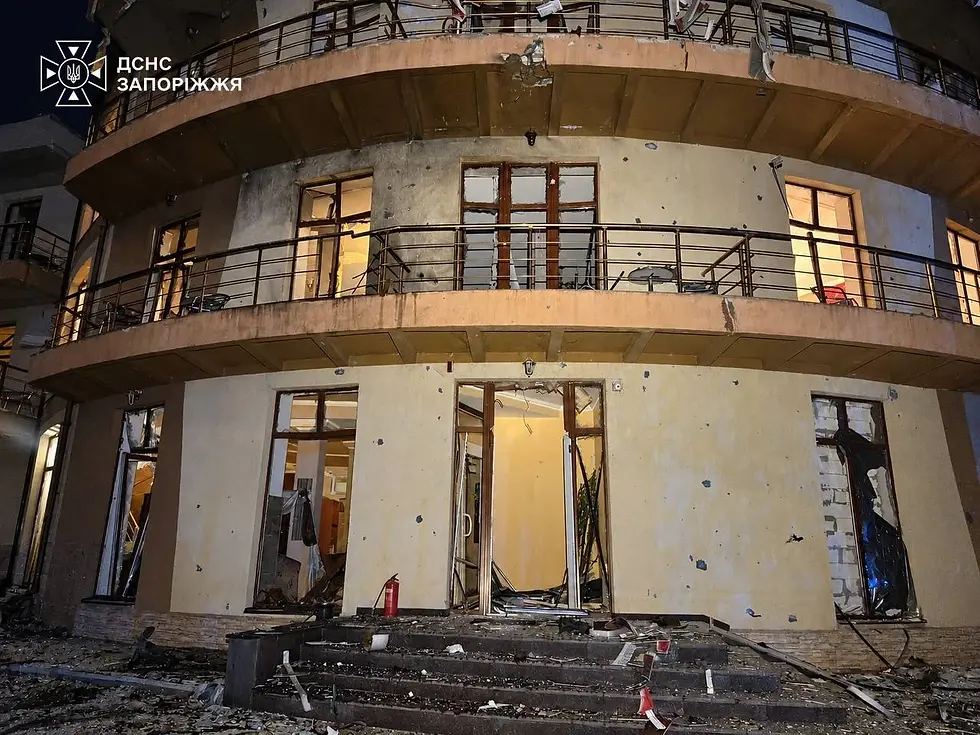
Strike damage in Zaporizhzhia, October 26, 2026. Photo: State Emergency Service via ArmyInform (CC BY 4.0).
What to watch next week
Watch the Oleshky window at 22:59 tonight: an extension would be the war's first rolling local ceasefire; a lapse returns the delta to the drone war. Watch Abu Dhabi after November 4, the morning intercept ratios while the European loans are negotiated, the refinery tempo, and the first concrete step, or the next sunk ship, on the grain corridor.
The channel runs this ledger daily at t.me/TheLeaflet.
Read next: Ukraine Patriot Missile Shortage: The Night the Ballistic Shield Ran Empty and Black Sea Ship Attacks: Russia's War on the Grain Fleet.
Want this level of analysis in your inbox? Drop your email in the subscribe box at the bottom of this page and the channel will send you the Sitrep Digest: the best of these briefs in a five minute read.
Reader question: if the 500 PAC-3 sale really delivers after 2030, what should Kyiv offer European capitals to move their interceptors this winter? Drop your take in the comments, or tell the channel what to cover next.
Sources
Kyiv Post (Nov 1, 2026); United24 Media (Nov 1, 2026); ISW (Oct 31, 2026); Al Jazeera (Oct 31, 2026); Kyiv Independent (Oct 30, 2026); Reuters (Oct 30, 2026); Euromaidan Press (Oct 30, 2026); The Insider (Oct 28, 2026); ArmyInform (Oct 26-30, 2026). Photos: Ukraine's State Emergency Service and the 37th Marine Infantry Brigade via ArmyInform (CC BY 4.0).



Comments