


US Midterm Results: Democrats Take Congress, and What That Actually Changes for Ukraine

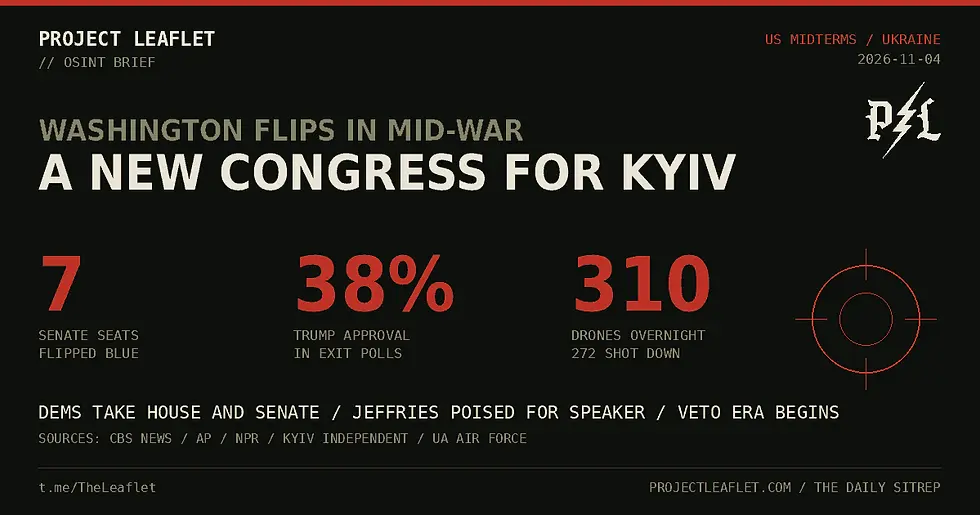
In brief: Democrats took both chambers of Congress in Tuesday's US midterms, flipping seven Republican Senate seats on a night exit polls carried by CBS News put Donald Trump's approval at 38 percent. For Ukraine, the result promises harder oversight of the peace push and the diesel deal, but the president's veto and his executive workarounds mean the war's Washington math changes less than the map suggests.
Part of our NATO Security coverage.
The US midterm results came in fast, and in one color. CBS News projected Democratic control of the House at about 10:15 pm Eastern on Tuesday, November 3, and called the Senate shortly after 11:30 pm. By Wednesday morning Democrats had flipped seven Republican-held Senate seats and Hakeem Jeffries stood poised to become the first Black Speaker in the chamber's history. Russia had opened the eve of the vote by firing 76 missiles and 289 drones into Ukraine's grid, a barrage Kyiv read as a message timed to America's vote. The voters sent one back.
How the US Midterm Results Broke: Seven Senate Flips and a Blue House
Per CBS News, the seven Republican Senate seats that fell: Texas, where James Talarico beat Ken Paxton in the first Democratic Senate win there since 1988; Kansas, where Adam Hamilton became the first Democrat the state has sent to the Senate since 1932; Ohio, where Sherrod Brown took a seat back from Jon Husted; Iowa (Josh Turek over Ashley Hinson); North Carolina (Roy Cooper over Michael Whatley); South Carolina (Annie Andrews over Darline Graham); and Maine, where Troy Jackson ended Susan Collins's three-decade run. Collins conceded. Alaska and Mississippi were still uncalled by dawn.

Photo: Architect of the Capitol, public domain, via Wikimedia Commons
The House swing was as broad: the Cook Political Report's estimate, relayed by Forbes, had Democrats gaining as many as 25 seats, their largest majority since 2009. Exit polling carried by CBS put Trump's approval at 38 percent, possibly a record low for a president in a midterm. A CNN exit poll cited by Forbes found about 60 percent saying the United States made the wrong decision attacking Iran.
Trump's reaction came in stages. "I wasn't on the Ballot and if I was, we would have won IN A LANDSLIDE!" he posted on Truth Social, per CBS. The line that matters most for the next two years came before polls closed, in a CBS interview: "I have the ultimate power, it's called 'veto.'"
What a Democratic Congress Can Do for Ukraine
Ukraine barely featured in the campaign. Historian Allan Lichtman told Hromadske before the vote that the war "has been eclipsed by the war in Iran as a voting issue." But the incoming majority's intentions are on the record: Rep. Jim Himes said in October that Democrats "would move quickly to restart aid" if they took the House, per Breaking Defense. There are levers waiting. On October 11, Republican Rep. Brian Fitzpatrick, whose Pennsylvania seat Democrats flipped, introduced bipartisan legislation to stop the White House from unilaterally lifting sanctions on Russian oil, and two days later a bipartisan Senate group urged the administration to reverse the diesel arrangement with Moscow, per Hromadske. Sen. Richard Blumenthal's verdict on that deal: "It's negligible. It's a pittance." Expect that fight, plus subpoena-backed oversight of the Patriot delivery gap and the missile-warning lapses this channel has tracked since October.

Photo: official portrait, US Congress, public domain, via Wikimedia Commons
The limits are just as concrete. A veto override needs two thirds of both chambers, and the new Congress is not seated until January, leaving Trump two months of lame-duck runway. Nevada Joan Lee of the European Council on Foreign Relations told The Parliament Magazine that "pocket rescissions" let the White House simply decline to spend appropriated money, so a passed Ukraine package is not a delivered one, and that September's Graham sanctions act, so far used for waivers rather than pressure, "took a lot of power out of Congress's hands." Reuters reported November 1 that White House officials were already exploring ways to pursue the agenda without new legislation. James Green of the Centre for European Reform: "it's going to be very difficult for Congress to change the overall route over the next two years."
What Moscow Heard
Russia's first reading was dismissive on the surface and sour underneath. Deputy Foreign Minister Sergei Ryabkov told RIA Novosti that "the approach of the activist wing of the Democratic Party towards Russia is extremely negative," per NPR. State daily Rossiyskaya Gazeta went further: "Brussels, brace yourself. After the Republicans' defeat, Trump's wrath will fall on Europe." The Kyiv Independent's own headline read the same tape the other way: a "blow to Trump, potential boost for Ukraine."
Juraj Majcin of the European Policy Centre argued that a poor Republican showing could frustrate Trump into further restricting support for Ukraine, and German MEP Bernd Lange warned that a "lame duck could become an angry duck." The timing matters because the diplomacy is live. Kyiv Independent reporting in October said Trump wanted progress on his peace track before the midterms, Russian officials have pointed to trilateral technical talks in Abu Dhabi in the first half of November, after the US vote, and Zelensky has said Russia appears serious about that round, per Ukranews. The election removes Trump's domestic deadline and hands Moscow a weakened counterpart. Europe mostly held its tongue; German Defense Minister Boris Pistorius congratulated Democrats on a "historic victory," per NPR.
The War Did Not Wait for the Count
While America counted, Russia launched 310 strike drones overnight into Wednesday, 81 of them jet-powered, Ukraine's Air Force reported. Air defenses downed 272, including 64 of the jet types, with impacts at 19 locations and energy facilities hit in six regions: Odesa, Kirovohrad, Zhytomyr, Ternopil, Volyn and Rivne. DTEK announced emergency outages in several regions including Kyiv, and the past day's toll stood at 6 killed and 50 injured nationwide, per the Kyiv Independent.

Image: still from 8th Air Assault Corps video, via ArmyInform, CC BY 4.0
Ukraine's ledger also went public. The Defense Ministry reported at least 30 successful strikes on strategic Russian targets in October, including seven defense-industry and missile-space facilities and three airfields, per Kyiv Post, and on Wednesday morning a drone set an Ozon warehouse in Adygeysk in southern Russia on fire. The 8th Air Assault Corps published video of a Pantsir-S1 destroyed on the North Slobozhansky axis, a system it valued at about 15 million dollars, via ArmyInform. In Berlin on Tuesday, Zelensky and Chancellor Friedrich Merz discussed a winter support package, Germany's planned 11.6 billion euros in aid for 2027, and new PAC-2, PAC-3 and IRIS-T deliveries, per Kyiv Post.
Why It Matters
Every lever of US support that failed Ukraine this autumn, the Patriot trickle, the warning gaps, the Starlink caps, the diesel waiver, failed inside a Washington where nobody holding a gavel wanted to ask questions. That ends in January. Congress cannot force Trump to arm Kyiv, but it can make every concession to Moscow cost something at home, and it can write the record the 2028 field will run on. For Moscow, the clock just inverted: the deal Russia wants is best signed before January, from a president who may prefer a win to a stalemate.
What to Watch
Whether Trump treats the lame-duck window as deal-closing time in Abu Dhabi. Whether the Fitzpatrick sanctions bill and the 500-interceptor Patriot sale survive the postelection agenda. The two uncalled Senate races in Alaska and Mississippi, which set the size of the override math. And the first week of January, when the subpoenas get signatures.
The channel will be tracking all of it. For the live feed between briefs, follow us at t.me/TheLeaflet.
Read next: Patriot Missile Sale to Ukraine: 500 PAC-3 Interceptors Approved on the Night Kyiv's Water Went Out and Serbia Election Results: The Student Movement That Unseated Vucic, and What Moscow Just Lost.
Want this level of analysis in your inbox? Drop your email in the subscribe box at the bottom of this page and the channel will send you the Sitrep Digest: the best of these briefs in a five minute read.
Here is the question we are chewing on: does a Democratic Congress make a bad peace deal less likely, or does it push Trump to close one fast before January? Drop your read in the comments, or tell the channel what to cover next.
Sources
CBS News (Nov 4, 2026), Forbes (Nov 4, 2026), NPR (Nov 4, 2026), Kyiv Independent (Nov 4, 2026), Kyiv Post (Nov 4, 2026), ArmyInform (Nov 4, 2026), Ukrinform (Nov 4, 2026), Hromadske (Nov 2, 2026), The Parliament Magazine (Nov 4, 2026), Breaking Defense (Oct 15, 2026), Ukranews (Nov 2026). Photos: Architect of the Capitol and US Congress via Wikimedia Commons (public domain); 8th Air Assault Corps video still via ArmyInform (CC BY 4.0).


Comments