


Kyiv Blackout: Russia Put 3 Million People in the Dark, and Named Its Price to Stop

Updated: Oct 10

In brief: Russia's October 8 strike on a key Kyiv energy facility left more than 3 million capital residents without power, halting the metro and cutting water pressure, with emergency cuts lasting into Friday morning. The same week, US and Ukrainian officials told the Kyiv Independent that Moscow will consider the American energy ceasefire proposal, for a price: sanctions relief.
Part of our Ukraine War Analysis coverage.
At 20:16 on Thursday, October 8, Ukraine's Energy Minister Denys Shmyhal posted that Russia had hit "one of the energy facilities important for the city of Kyiv" and that the drone attack was still ongoing. By then the lights were already going out. Within hours most of the capital's neighborhoods had no power, and the Kyiv blackout was the deepest since the cascade failure of late January. More than 3 million residents lost electricity, per officials cited by the Kyiv Independent. On Friday morning, while repair crews were still at work, a Ukrainian delegation was headed to the United States to discuss the one deal that could make nights like this stop: an energy ceasefire that Moscow now says it will entertain, at a price.
How the Kyiv Blackout Happened
The blackout did not arrive in one blow. Russia began working the grid around the capital on Tuesday, October 6, and by Wednesday emergency shutdowns were overriding the published schedules, per Kyiv Post. On Thursday, scheduled cuts ran up to 12 hours and DTEK announced emergency shutdowns in four Kyiv Oblast districts. Then came the evening strike on the facility Shmyhal would not name.
The effects stacked fast. The voltage drop temporarily halted metro trains and escalators, per the Kyiv City State Administration, and part of the surface network was suspended. Kyivvodokanal reported that reduced power to pumping stations dropped water pressure across the right bank, with four right-bank districts warned of interruptions. Mayor Vitali Klitschko said the day's drone strikes killed four people and injured at least 19 in Kyiv.

Kyiv's night lights in March 2022, in the first weeks of the full-scale invasion. Satellite imagery: NASA Earth Observatory Black Marble, public domain.
Restoration was quick by grid-war standards. At 11:15 on Friday, October 9, DTEK Kyiv Electric Networks said the capital had moved off emergency cuts and back onto scheduled stabilization outages, on Ukrenergo's instruction, per Mezha. Ukrenergo kept all-day restrictions in place across the affected regions and asked consumers to conserve through the evening peak. The system bent without breaking. But by Prime Minister Serhii Koretskyi's September count, strikes on energy facilities have come almost daily since summer, a campaign that reopened with the Zircon-led mass strike of September 30, and the heating season has not started.
Putin's Price for the Energy Truce
The timing of the capital's darkest night is the story. On Friday the Kyiv Independent published an exclusive reporting that Russia has attached a price to the energy ceasefire Washington is pushing: sanctions relief. Per anonymous US and Ukrainian officials, Kremlin envoy Kirill Dmitriev raised sanctions relief during two September US visits, in meetings with Steve Witkoff and Jared Kushner, and Moscow wants the truce linked to a Black Sea ceasefire. Which sanctions Moscow wants lifted is unclear even to people briefed on the talks. The channel has covered the first offer of this truce since September; the pattern since has been escalation priced into every pause.
The public and private tracks do not match. Kremlin spokesman Dmitry Peskov said on October 8 that Russia saw no point in a sectoral ceasefire covering what he called Ukraine's "Achilles' heel," the energy sector. Privately, per two Ukrainian officials and one US official, Russian negotiators have signaled they would consider it. A Ukrainian delegation was due in the United States on Friday to meet Trump's envoys, and Trump reportedly wants visible progress before the US midterms, per several Ukrainian officials. Kyiv's fear, as one official put it: "Every time negotiations begin, they come up with more and more demands." A senior Ukrainian defense official told the outlet Moscow is inflicting maximum damage now to build leverage. Thursday's blackout reads as exactly that.
Ukraine's Answer: Rocket Fuel and Data Centers
Kyiv is not waiting for the truce to answer. Overnight into Friday, Russian Telegram channels, including Exilenova+, reported explosions at the Redkino Experimental Plant in Tver Oblast, which produces Decilin-M rocket fuel components the channels tie to the Kh-55 and Kh-101 cruise missile family. Ukraine's military has not commented, and the Kyiv Independent could not verify the reports.
The data center war is more visible. Yandex confirmed, in a statement carried by Vedomosti, that a drone attack overnight into Friday completely disabled several modules of its Kaluga Oblast data center, one day after a strike set fire to its Sasovo facility in Ryazan Oblast, home to tens of thousands of servers and two of the company's three AI supercomputers. Kaluga Governor Vladislav Shapsha said nine people were injured in the oblast, and Russian authorities claimed 26 drones downed over the region. Zelensky did not claim the strikes, but on Thursday he was blunt: Russia has been striking Ukrainian data centers, and "we always respond in kind."
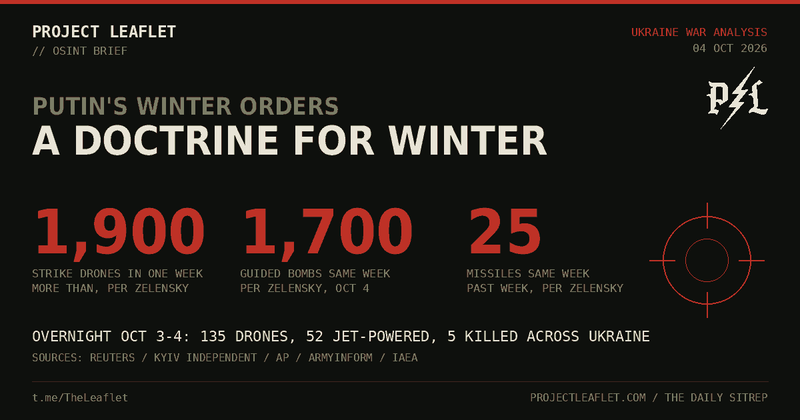
Russia's own overnight package into Friday was 136 drones, 93 of them jet-powered Shahed types, of which Ukraine's Air Force says 114 were downed or suppressed. What got through closed out a brutal 24 hours: at least 41 killed and 67 injured across Ukraine per local authorities, 35 of the dead in Donetsk Oblast per Governor Vadym Filashkin, most of them at the Kramatorsk bus stop the channel covered on Thursday. In Zaporizhzhia, glide bombs killed one person and injured seven, including a child.

Burned cars at the scene of the October 9 morning airstrikes on Zaporizhzhia. Photo: State Emergency Service of Ukraine via ArmyInform, CC BY 4.0.
Survival Mode: The Fifth War Winter
Friday brought the recriminations. After a conference call with military and government officials, Zelensky wrote that Kyiv's city authorities had failed to implement resilience measures "in almost all respects," calling delays in regional resilience plans "absolutely unacceptable," per Kyiv Post. Klitschko, talking to AFP, described a capital in "survival" mode, building backup heating and stockpiling fuel, food and water, and answered the president in kind: "Finding scapegoats won't make people warmer."

An apartment block damaged in the October 9 morning strikes on Zaporizhzhia. Photo: State Emergency Service of Ukraine via ArmyInform, CC BY 4.0.
Help is pricing in a hard season. On Thursday, UK Foreign Secretary Ed Miliband announced a 54 million pound (about 71 million dollar) winter package on his first trip to Ukraine in the role, 20 million of it for emergency grid repairs, generators and solar power. In September, Shmyhal said Kyiv had obtained Russian planning documents for winter strikes on power, heating, water and sewage systems. Winter 2026-27 is Ukraine's fifth at war, and this is the first in which the capital has gone mostly dark before the heating season even began.
Why It Matters
The blackout and the truce are the same story. Russia is spending drones and missiles to prove it can switch off a European capital precisely while Washington tries to buy that capability off the table, and Moscow wants the price paid in sanctions relief, not reciprocity. If blackouts become a recurring feature of October, the energy ceasefire stops being a humanitarian pause and becomes what Kyiv fears: a lever rewarding the side with the bigger club. Every hour of darkness in Kyiv is now an input into a negotiation happening in Washington the same day.
What to Watch
Watch what the delegation brings back from the Friday and Saturday meetings, and whether the late-October trilateral Witkoff floated materializes. Watch whether Moscow's sanctions demand gets specific, and whether frozen assets enter the conversation. Watch the next mass strike window: Ukrenergo's all-day restrictions and evening conservation appeals will show how much margin the grid has left. And watch for Ukraine's next reply against Russian fuel and compute targets. The respond-in-kind campaign is accelerating.
The channel will be tracking all of it. For the raw feed as it happens, join us on Telegram at t.me/TheLeaflet.
Read next: Putin's New Strike Doctrine: Winter Orders Against Civilians and Germany Ukraine Aid Package: Merz Brings Kyiv $1.46 Billion.
Want this level of analysis in your inbox? Drop your email in the subscribe box at the bottom of this page and the channel will send you the Sitrep Digest: the best of these briefs in a five minute read.
Reader question: if an energy ceasefire is signed and the lights stay on through December, does Ukraine win or lose by pausing its refinery and data center campaign while sanctions get renegotiated? Drop your take in the comments, or tell the channel what to cover next.
Sources
Kyiv Independent (Oct 8-9, 2026), Kyiv Post (Oct 9, 2026), Ukrinform (Oct 8, 2026), Euromaidan Press (Oct 8, 2026), Mezha (Oct 9, 2026), AFP via Kyiv Post (Oct 9, 2026), Vedomosti via Kyiv Independent (Oct 9, 2026), ArmyInform (Oct 9, 2026). Photos: State Emergency Service of Ukraine via ArmyInform, CC BY 4.0; satellite imagery NASA Earth Observatory, public domain.


Comments