


Operation Carthage: The Drug Cartel Investigation That Reached Inside Ukraine's SBU

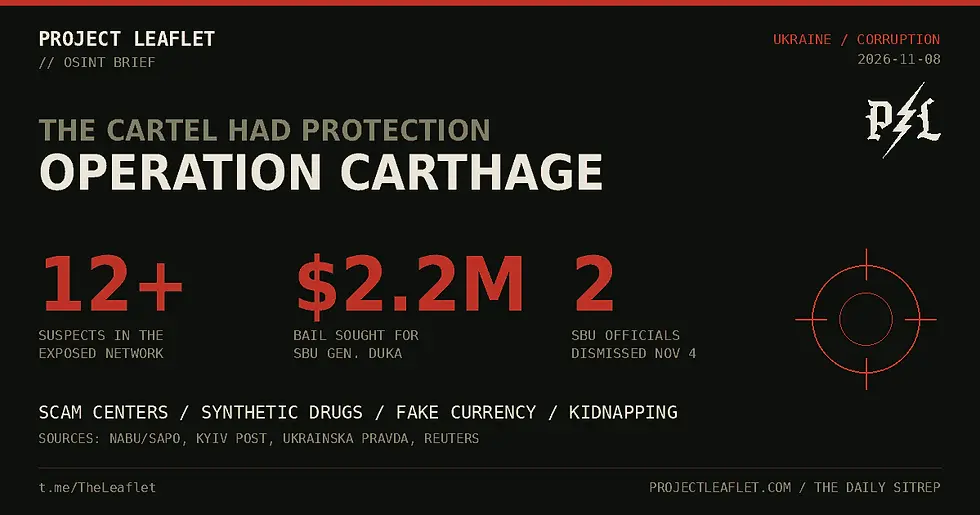
In brief: Ukraine's anti-corruption agencies say a criminal organization paid senior SBU and police officials to protect scam call centers, synthetic drug sales and counterfeit currency production tied to the transnational Khimprom cartel. President Zelensky called the week's revelations disgraceful, confirmed dismissals inside the SBU, and approved a draft law restoring mandatory asset declarations for every SBU employee.
Part of our Ukraine War Analysis coverage.
When detectives from the National Anti-Corruption Bureau arrived to search the suburban residence of an SBU general on Wednesday, November 4, the general did not cooperate. According to NABU detective unit chief Oleksandr Abakumov, Maj. Gen. Serhiy Duka threatened the detectives with a handgun, smashed two smartphones and a hard drive with a hammer, and was shielded for two hours by armed operatives from the SBU's own Alpha unit, who tried to evacuate him. That standoff, one arm of the state against another in the middle of a war, is the shortest summary of what Operation Carthage has become.
What Operation Carthage Found
On the evening of November 4, NABU and the Specialized Anti-Corruption Prosecutor's Office released recordings and case materials from Operation Carthage, an anti-corruption and counter-narcotics investigation that has been running for months. The agencies say they exposed a criminal organization of at least 12 people that paid regular bribes to senior law enforcement officials. In exchange, the network's businesses ran unhindered: fraudulent call centers that scammed Ukrainians and foreigners, synthetic drug sales, and the illegal production of counterfeit cigarettes and foreign currency. Ukrainska Pravda reported that episodes under investigation also include kidnapping and torture.

The National Anti-Corruption Bureau of Ukraine in Kyiv. Photo: Mr.Rosewater, Wikimedia Commons, CC BY-SA 4.0
Investigators say the organization was built by a three-time convicted man code-named Criminal, identified in Ukrainian media as Andrii Osipov. His partner, code-named Mexican, is described by NABU as the founder and leader of the Khimprom drug cartel: Russian-born Yegor Burkin, who also holds Ukrainian documents under the name Yehor Levchenko. He is wanted in Ukraine and, according to the Global Initiative Against Transnational Organized Crime, reportedly lives in Mexico. A Kyiv Post review of the case materials describes him as a Russian citizen with ties to the FSB.
The recordings reach past bribery. NABU says members of the organization discussed personnel reshuffles inside the SBU, and that their circle included senior SBU officials involved in the summer 2025 attempt to strip NABU and SAPO of their independence. In one released episode, suspects discussed a violent attack on investigative journalist Denys Bihus over a Bihus.Info report into U420, a retail chain that investigators say sold narcotics disguised as legal souvenirs.

Investigative journalist Denys Bihus at a 2019 rally in Kyiv. Photo: VoidWanderer, Wikimedia Commons, CC BY-SA 4.0
A General, a Hammer, and a 2.2 Million Dollar Bail Request
The institutional fallout moved fast. On November 4, SBU head Oleksandr Poklad dismissed two senior officials named in the investigation, and NABU searched the office of Anton Kravchuk, head of the SBU's Main Department of Internal Security, according to Ukrainska Pravda. The State Bureau of Investigation opened a separate criminal inquiry into the armed obstruction at Duka's residence.
On Friday, November 6, prosecutors asked the High Anti-Corruption Court to order pre-trial detention for Duka, formerly first deputy head of the SBU's Department for the Protection of National Statehood, with bail set at 2.2 million dollars, per the Kyiv Post. The same week, the court set bail of 15 million hryvnias, about 330,000 dollars, for Volodymyr Tsenov, first deputy head of the National Police's Strategic Investigations Department, which was subsequently deposited, and remanded Kyiv regional police official Oleksandr Demianchuk in custody without bail on charges involving counterfeit currency production and aiding a gang implicated in torture.

The SBU headquarters on Volodymyrska Street in Kyiv. Photo: Bibikoff, Wikimedia Commons, public domain
Carthage has been eating through Ukraine's law enforcement for months. The same investigation led to the resignation of Prosecutor General Ruslan Kravchenko in September, after a protection ring for scam centers was found operating inside the Prosecutor General's Office; that office later dismissed seven employees named in the case. The Global Initiative Against Transnational Organized Crime estimates that the scam-center industry Khimprom operates in generates roughly 1 billion dollars a month worldwide.
Khimprom Is Expanding Into Europe
In his Saturday evening address on November 7, Zelensky turned the case into a warning for Ukraine's partners, saying the cartel is moving west. "There is information that this criminal has already started operations in Poland. There is also information that he is trying to enter Germany with synthetic drugs. We will pass all the information we have to our partners," he said of Burkin, per the Kyiv Post's translation. He added that Kyiv had raised the Khimprom case with America "at the appropriate level," and that "a result is needed."
Dismissals and Declarations
Zelensky did not soften the language about his own security service, calling the week's news "frankly unpleasant, frankly disgraceful, absolutely impermissible things." He confirmed that dismissals inside the SBU have already begun and promised further personnel decisions. In the same address he credited the SBU's Alpha special unit as the component that inflicts the most damage on the Russian occupiers, a reminder of how much of Ukraine's deep-strike war runs through the same agency now under scrutiny.
The structural answer is a draft law the president approved the same day: mandatory asset declarations for every SBU employee, and for personnel of other state agencies, so that their lifestyles and assets are open to public scrutiny and accountability. He asked parliament to adopt it without delay. Reuters noted that asset declarations have been one of Ukraine's most powerful corruption-monitoring tools, and that rooting out graft is a condition for EU membership and continued financial aid.
The Grid War Did Not Pause
The scandal broke against the usual backdrop of Russia's energy campaign. Overnight into Sunday, November 8, Russia attacked with three Kh-59/69 guided missiles launched from over the Sea of Azov and 164 Shahed-type drones, 112 of them jet-powered, alongside Gerbera and Parodiya decoys; the Air Force reported 137 drones downed or suppressed by morning. More than 600,000 customers lost power across five districts of Dnipropetrovsk region, where hospitals switched to generators, according to the regional administration.
In Odesa, officials said one person was killed and a food warehouse burned; Russian forces struck the same warehouse again on Sunday morning, regional governor Oleh Kiper said. In a Dnipro suburb, a drone destroyed a private house and killed one person, per regional head Oleksandr Hanzha, and the State Emergency Service said a Sunday morning strike in Zaporizhzhia district deliberately targeted rescue workers. Ukrenergo kept hourly outage schedules running nationwide all day.
Why It Matters
The SBU is the most powerful institution in wartime Ukraine, with sweeping law enforcement and military powers and a record that runs from counterintelligence to Operation Spiderweb. Operation Carthage does not erase that record, but it tests the thing partners actually fund: whether Ukraine's oversight architecture can police its own security services in wartime. The honest read cuts both ways. The same NABU that senior officials tried to defang in the summer of 2025 is now charging generals, on camera, through an anti-corruption court, which is the system working. The Global Initiative's harsher read is that NABU looks like an island doing this work almost entirely alone. Both can be true, and EU accession reviews will weigh each.
What to Watch
Whether the Rada passes the SBU asset declaration law quickly, and in what form. The High Anti-Corruption Court's rulings on Duka's detention and bail. Poklad's next dismissals, which Zelensky has already promised. Any sign that Poland or Germany open their own Khimprom cases on Kyiv's intelligence. And the calendar: US-mediated technical talks are expected in Abu Dhabi on November 10 and 11, days after the midterms reshaped Washington's Ukraine politics, which means Ukraine's corruption headlines landed right before its diplomats sit down to argue for more support.
The channel will be tracking the Carthage case files as they unseal. For the running intel picture between briefs, follow t.me/TheLeaflet.
Read next: Witkoff Putin Meeting: A Freed American, a Peace Paper at the Palace, and the Lines Russia Will Not Cross and Russia Energy Attacks Are War Crimes: The UN Verdict, and the 16 Missile Night That Answered It.
Want this level of analysis in your inbox? Drop your email in the subscribe box at the bottom of this page and the channel will send you the Sitrep Digest: the best of these briefs in a five minute read.
Reader question: Should wartime security services be subject to the same public asset declarations as every other agency, or does that transparency expose officers to Russian targeting? Drop your take in the comments, or tell the channel what to cover next.
Sources
NABU and SAPO statements (Nov 4, 2026); Ukrainska Pravda (Nov 4, 2026); Censor.NET (Nov 5, 2026); Kyiv Post (Nov 6 and Nov 8, 2026); Reuters (Nov 7, 2026); The New Voice of Ukraine (Nov 7, 2026); Global Initiative Against Transnational Organized Crime (Nov 7, 2026); Mezha (Nov 4, 2026); UNN (Nov 8, 2026); Ukrinform (Nov 8, 2026); UA News (Nov 8, 2026). Photos: Mr.Rosewater (CC BY-SA 4.0), VoidWanderer (CC BY-SA 4.0) and Bibikoff (public domain), via Wikimedia Commons.


Comments