


Ukraine Ground Drones: 31,398 Missions in One Month, and the Supply Line That No Longer Needs a Human


In brief: Ukraine's Defense Ministry says ground robots carried out 31,398 verified logistics and evacuation missions in October, the first month ever above 30,000 and more than four times January's figure. The count has risen every single month of 2026, because the drone kill zone has made the last miles to the front line too dangerous for humans in trucks.
Part of our Drone Warfare coverage.
The busiest new supply line in Ukraine does not have a single driver on it. On November 6, Ukraine's Defense Ministry announced that units carried out 31,398 logistics and evacuation missions with unmanned ground vehicles in October, the first time the monthly count has crossed 30,000. Every one of those runs was logged in the DELTA battlefield system and verified by specialists at the Brave1 defense tech cluster. And every month of 2026 has set a new record.
What Ukraine's Ground Drones Did in October
The progression reads like a production curve, not a battlefield statistic. January: 7,511 missions. February: 7,960. March: 9,072. April: 11,028. May: 14,059. June: 16,663. July: 19,935. August: 25,136. September: 28,491. October: 31,398. Ten months, ten records, and a more than fourfold increase, according to the Ministry of Defense figures carried by Ukrinform.
What the robots actually do is deliberately unglamorous. On the most dangerous sections of the front they haul ammunition, food and water to positions no truck can reach alive, and they carry wounded soldiers, and the fallen, back out. The ministry counts only logistics and evacuation missions in this ledger; strike and mining work by armed ground robots runs on top of it.
The verification layer matters as much as the number. Missions earn units ePoints only after Brave1 specialists confirm them in DELTA, which makes 31,398 a floor built from audited combat data rather than a press release estimate.

A Ukrainian serviceman with a ground robotic system. File photo: ArmyInform, CC BY 4.0
The Kill Zone Pushed Logistics Off the Road
The reason for the curve is the same one reshaping everything else in this war: the drone kill zone. As the Kyiv Independent put it in its November 6 report, the saturation of Russian FPV drones has effectively barred traditional vehicles from the logistics runs, rotations and casualty evacuations they handled in the war's earlier years. The last stretch behind the front line became a place where a pickup truck is a target and a wounded soldier can wait days for a safe extraction window.
Ukraine's answer, over 2025 and 2026, was structural rather than improvised. UGV companies and battalions now exist in almost every Ukrainian brigade, per the Kyiv Independent. Defense Minister Mykhailo Fedorov set the ceiling back in April: the goal is for 100 percent of frontline logistics to be performed by robotic systems, as reported by Defense News, which also noted that Ukraine's General Staff credits robotic platforms with cutting personnel casualties by up to 30 percent.
The machines themselves are deliberately simple: wheeled and tracked carriers hauling 200 to 300 kilograms under fire, per the Defense Ministry.

An operator of the National Guard's Argos unmanned systems company with control equipment for the unit's new ground robot. Photo: National Guard of Ukraine via ArmyInform, CC BY 4.0
ePoints, Brave1 Market and 22,000 Robots on Contract
The system behind the number is an incentive economy. Verified UGV missions earn units ePoints, which they can spend on the Brave1 Market military marketplace for FPV drones, electronic warfare kit and more ground robots. Run missions, earn robots, run more missions. By late July the military had placed nearly 1.9 billion hryvnias in ePoints orders for ground robots, and the ministry had contracted more than 22,000 UGVs since the start of the year, nearly double the total for all of 2025, per ArmyInform.
The fleet is diversifying fast at both ends. In late October the ministry added a new class to Brave1 Market, amphibious ground robots, after one completed a 40 kilometer combat mission, per United24 Media. And on November 7 the National Guard's Argos unmanned systems company of the 2nd Shostka Regiment showed the heavy end of the spectrum: a car-sized, diesel, all-wheel-drive UGV that hauls up to 1.5 tons of cargo or evacuates three wounded soldiers at once. "This is not just the compact robotic complex we are used to seeing. In its dimensions and construction it is closer to a full vehicle," an operator with the call sign Odinson said via ArmyInform. By June, National Guard ground robots alone had moved 1,477 tons of supplies and helped evacuate 113 wounded.
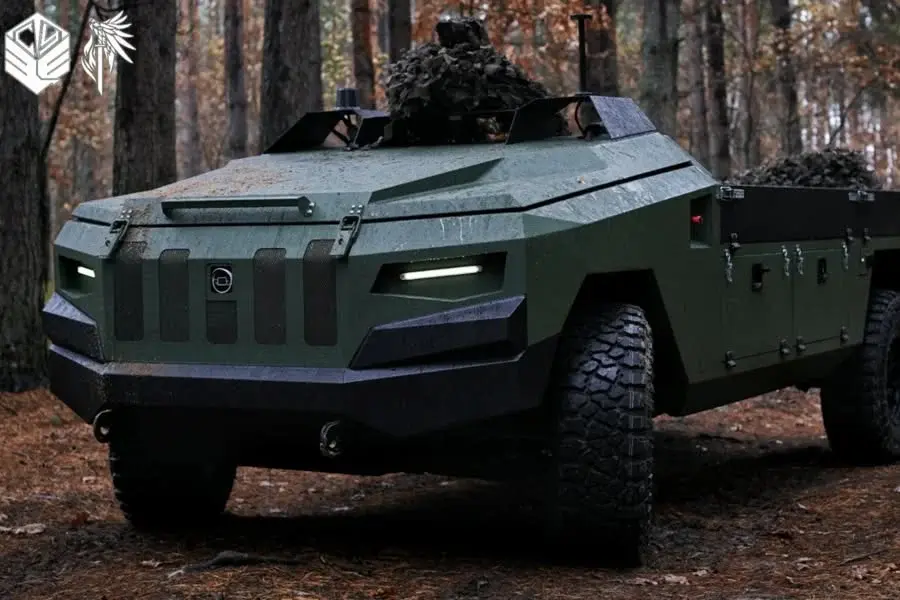
The new heavy ground robot delivered to the National Guard's Argos unmanned systems company, published November 7. Photo: National Guard of Ukraine via ArmyInform, CC BY 4.0
The Pentagon Is Taking Notes
Ukraine's robot supply line is now shaping procurement in Washington. The Pentagon committed more than 115 million dollars to UGV projects in fiscal 2026, according to public records and GovTribe data cited by Defense One, which framed the spending around lessons from Ukraine. "What Ukraine says they need is something that's not very expensive, something that is attritable, something that if lost could be easily replaced," analyst Samuel Bendett told the outlet. "These are not overly complicated UGVs. They're relatively simple."
The American approach diverges on one axis: autonomy. Where Ukrainian robots are mostly remote controlled and cheap enough to lose, US programs put more weight on systems that keep working when communications are cut, such as the roughly 25 million dollars the Marine Corps and the 75th Ranger Regiment are spending on Overland AI's IBEX robots, per Defense One. Ukrainian builders are meanwhile exporting the doctrine: DevDroid tested its machine gun UGVs with the Italian Army in October, plugged into a NATO tactical network, per United24 Media. The traffic, in other words, now runs both ways, much like the Ukraine US drone deal that put Ukrainian interceptors in front of American bases.
Why it matters
31,398 missions in a month is roughly a thousand trips a day on average that no longer put a driver, a medic or an evacuation team inside the kill zone. For a military whose scarcest resource is trained infantry, that is not a technology story, it is a manpower story. It is the same scaling logic that stretched Ukraine's long-range strike drones out to Omsk: find the task that kills people, hand it to a machine, then let verified battlefield data decide which machines get bought next. Armed ground robots are already running assault missions, as the 3rd Army Corps showed during Operation Vivaldi; the logistics ledger is just the part the ministry can publish monthly.
What to watch
Whether November makes it eleven records in a row as mud and freezing rain test the wheeled part of the fleet. How fast the amphibious class spreads beyond its first units. Whether the Defense Ministry starts publishing strike and mining mission counts alongside the logistics ledger. And whether Russia's parallel UGV effort produces a verified mission system of its own or stays a showcase capability.
The channel tracks the robot war daily. For the raw feed between briefs, find us at t.me/TheLeaflet.
Read next: Operation Vivaldi Phase Three: The Bluff at Lyman That Took Back 51 Square Kilometers and 250 Prisoners and The Ukraine US Drone Deal Is Ready: Kyiv's Interceptors Already Defended American Bases From Iran.
Want this level of analysis in your inbox? Drop your email in the subscribe box at the bottom of this page and the channel will send you the Sitrep Digest: the best of these briefs in a five minute read.
Reader question: if you have operated or supplied ground robots at the front, which job do they still fail at most, mud, comms or payload? Drop it in the comments or tell the channel what to cover next.
Sources
Ministry of Defense of Ukraine via Ukrinform (Nov 7, 2026); Kyiv Independent (Nov 6, 2026); United24 Media (Nov 6, 2026 and Oct 28, 2026); ArmyInform (Jul 31, 2026 and Nov 7, 2026); Defense One via United24 Media (Nov 3 and Nov 5, 2026); Defense News (May 8, 2026). Photos: National Guard of Ukraine via ArmyInform, CC BY 4.0; ArmyInform file photo, CC BY 4.0.


Comments