


Yandex Data Center Attacks: Three Strikes in Four Days Took Russia's Cloud Offline

Updated: 1 day ago

In brief: Drones took down a third Yandex data center in four days early Sunday, this time outside Vladimir, after strikes on Sasovo on October 8 and Kaluga on October 9. More than 80 Yandex Cloud services reportedly went dark across Russia, and the company has now written drone attacks into its user agreement as force majeure.
Part of our Drone Warfare coverage.
The third one went down before dawn on Sunday, October 11. Residents of Vladimir, a regional capital east of Moscow, reported explosions overnight, and by morning Yandex had confirmed that its data center outside the city was completely shut down after a drone attack. The Yandex data center attacks now span three facilities in four days: Sasovo in Ryazan Oblast on October 8, Kaluga on October 9, and Vladimir overnight into October 11. Nobody has claimed them. But they are the clearest sign yet that the long-range war has opened a new target set: the buildings that run Russia's internet.
The Yandex Data Center Attacks, Day by Day
Sasovo came first. On the night of October 8, a strike set fire to Yandex's data center in the Ryazan Oblast town, a facility ArmyInform describes as housing tens of thousands of servers with a declared capacity of up to 12 megawatts. RBC-Ukraine reported a major fire with smoke visible from kilometers away, and Yandex fully suspended operations at the site. Reuters adds the detail that explains why this building mattered: two of the three supercomputers used to develop Yandex's AI models are housed at Sasovo. The same day, RBC-Ukraine noted, Yandex quietly removed data centers in four Russian regions from its own online maps.
Kaluga followed on October 9. Drones damaged one of the company's largest facilities, designed for more than 3,800 server racks with a projected capacity of 63 megawatts, according to United24 Media. Yandex said several modules were disabled, and the regional governor reported nine people injured.
Then Vladimir. Yandex Cloud first reported power interruptions in its ru-central1-a availability zone, which the Kyiv Independent places at the Vladimir facility. Regional governor Alexander Avdeyev confirmed drones struck infrastructure on the city's outskirts, starting a fire and knocking two electrical substations offline, which left about 5,000 residents without power. Houses closest to the site were evacuated, and no casualties were reported. By Sunday morning the company confirmed the data center was completely shut down.
What Went Dark Across Russia's Internet
The cumulative effect is visible from outside the country. NetBlocks data cited by United24 Media shows a sharp drop in Yandex and Yandex Cloud connectivity across Russia between October 8 and 11. After the Vladimir strike, Ukrainian and Russian monitoring channels reported more than 80 Yandex Cloud services down, from computing, databases and storage to the YandexGPT API. Those are reported estimates rather than confirmed counts, but they match what users saw.
The consumer side is where ordinary Russians felt it. The Alisa voice assistant, Yandex Music, the Telemost video service and smart home devices all reportedly went down after the Vladimir strike, and on Sunday the Yandex Go taxi app reportedly failed across Russia, with similar disruptions reported in Serbia, Kazakhstan, Belarus and Armenia, per monitoring channels cited by the Kyiv Independent.
Yandex itself, a company Reuters notes is sometimes called Russia's Google, has started talking like a wartime utility. On October 9 it called its data centers critical infrastructure and said staff were working around the clock. On October 10 it amended its user agreement to classify drone and missile attacks as force majeure, formally excusing itself from its contracts when the war reaches its servers.
Why Ukraine Is Hunting Russia's Cloud

A Defence Intelligence specialist arms a long-range strike drone. Still from a HUR video via ArmyInform, CC BY 4.0
Kyiv has not claimed the strikes, and Ukraine's Defense Forces have not commented. The closest thing to an explanation came from President Zelensky on October 8: 'We always respond in kind. As for data centers, you all know that they have targeted and continue to target ours.' Russia has indeed hit Ukrainian data infrastructure. RBC-Ukraine points to the Omega Telecom data center in Kyiv, which ceased operations after an attack, and the destroyed dline.ua facility.
The target logic is cold economics. A large data center is everything a deep-strike planner wants: big, fixed, impossible to hide, dependent on uninterrupted power and cooling, and expensive in both money and time to rebuild. The Sasovo supercomputers put Yandex's AI program inside the blast radius too. And the campaign slots neatly beside the refinery war. After the Perm refinery drone strike and the largest drone attack on Moscow, Ukraine has spent months proving it can reach Russia's fuel economy. The data center strikes extend that argument to Russia's digital economy.
The timing is not subtle either. The strikes landed in the same stretch of days that the Kyiv blackout put three million people in the dark, Putin named sanctions relief as his price for an energy truce, and Washington issued the Trump Russia diesel deal. Ukraine is demonstrating that its own escalation ladder still has rungs.
The Other Side of the Ledger
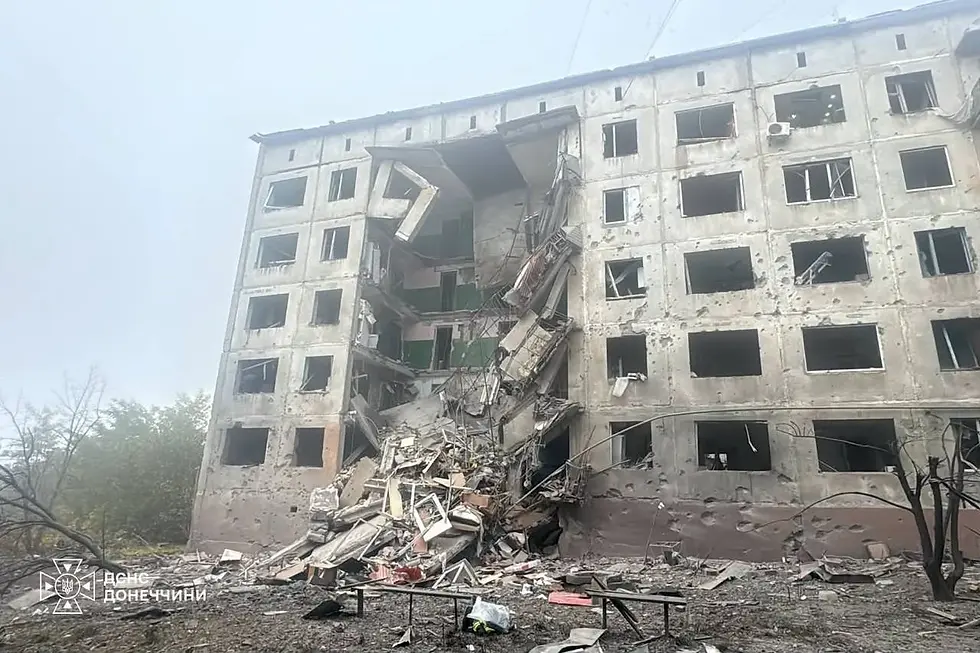
Apartment blocks in Sloviansk damaged by a Russian airstrike on October 11. Photo: State Emergency Service of Ukraine via ArmyInform, CC BY 4.0
Reciprocity cuts both ways, and the last 48 hours in Ukraine were brutal. Russian guided bombs hit a residential neighborhood of Zaporizhzhia in the early hours of October 10; by Sunday the toll had risen to at least 20 killed, including three children, with 32 injured, per the Kyiv Independent. Overnight into Sunday, strikes killed at least two more people and injured 25 across the country, with energy infrastructure around Kyiv targeted again.
In Sloviansk on Sunday, a Russian airstrike hit a nine-story and a five-story apartment block, injuring seven people and damaging nine buildings and a shop, according to the State Emergency Service. And Zelensky drew the line connecting all of it on October 11: Ukraine will stop striking Russian oil facilities only under an energy ceasefire, he said, adding that Putin does not want one.

Rescuers work inside a damaged apartment in Sloviansk, October 11. Photo: State Emergency Service of Ukraine via ArmyInform, CC BY 4.0
Why It Matters
Russia's sovereign internet runs on a short list of very large buildings, and Ukraine just demonstrated it can reach three of them in four days. Strikes on cloud infrastructure degrade services tens of millions of Russians touch daily, taxis, music, voice assistants, corporate hosting, without the mass-casualty optics of other target sets. The force majeure clause is the tell: Russia's flagship tech company is now pricing permanent war risk into every contract it signs. And in the truce diplomacy, Kyiv has added a second lever beside the refinery campaign. Every blackout ordered against Kyiv now has a named, matching answer.
What to Watch
Whether Yandex's remaining sites, including the ones it scrubbed from its own maps, are hit or hardened next. Whether Russian state services hosted on Yandex Cloud start failing publicly. Whether Moscow raises the data center strikes in the US-brokered talks that follow the Miami round. And whether Ukraine's military ever formally claims the campaign, which would convert deniable reciprocity into declared doctrine.
The channel will be tracking which building goes dark next. For the running feed between briefs, follow t.me/TheLeaflet.
Read next: Kyiv Blackout: Russia Put 3 Million People in the Dark, and Named Its Price to Stop and Flamingo Missile Production Strike: Russia's Birthday Barrage Names Six Plants and Kills 20.
Want this level of analysis in your inbox? Drop your email in the subscribe box at the bottom of this page and the channel will send you the Sitrep Digest: the best of these briefs in a five minute read.
Today's question: which campaign bites deeper into Russia's war economy, the refinery strikes or the data center strikes? Drop your take in the comments, or tell the channel what you want covered next.
Sources
Kyiv Independent (Oct 8, 2026; Oct 11, 2026), Reuters via The Moscow Times (Oct 11, 2026), United24 Media (Oct 11, 2026), RBC-Ukraine (Oct 11, 2026), ArmyInform (Oct 8, 2026; Oct 11, 2026), NetBlocks via United24 Media (Oct 11, 2026). Photos: Defence Intelligence of Ukraine video still via ArmyInform, CC BY 4.0; State Emergency Service of Ukraine via ArmyInform, CC BY 4.0.


Comments