


Russian Air Force Losses 2026: What's Left, Base by Base, and the Bombers Russia Cannot Replace

Updated: Sep 27

Four and a half years into the full-scale war, the Russian Aerospace Forces are a strange machine: visibly wounded, provably shrinking in the categories that matter most, and still dropping more bombs on Ukraine than at any point in the war. The channel has spent months tracking the strikes, the satellite passes, and the factory announcements one story at a time. This morning we put the whole file on one table: what the Russian Air Force has verifiably lost, which bases its aircraft still demonstrably operate from, what provably remains, what Russian industry has managed to replace, and how long the arithmetic holds if the war keeps running.
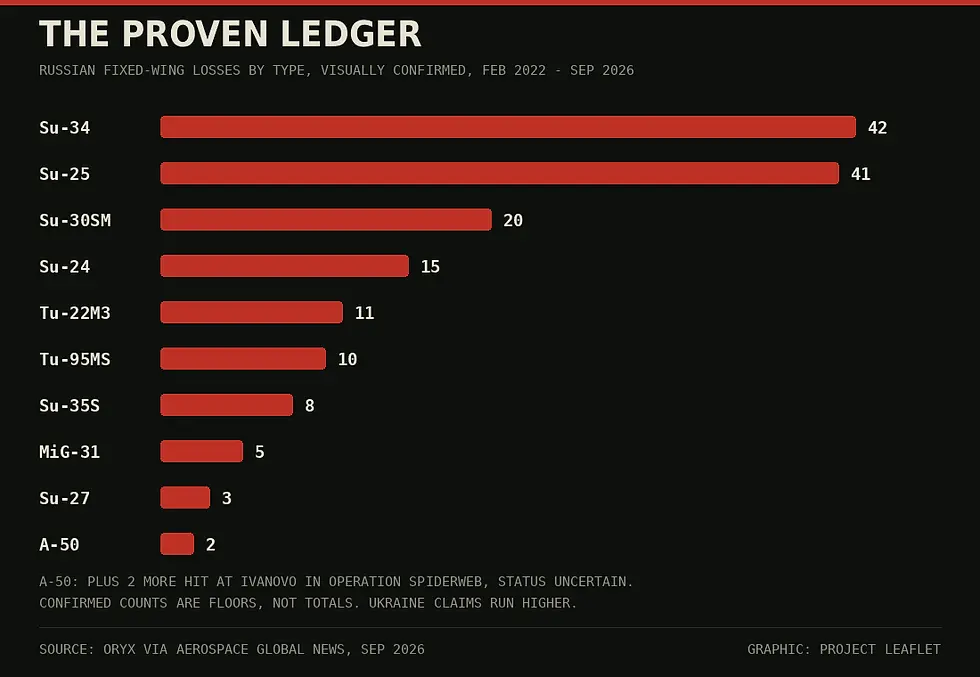
A note on method before the numbers. Everything below leans on visually confirmed or satellite-confirmed evidence where it exists, with claims attributed where it does not. That means the real numbers are almost certainly worse than the proven ones. Confirmed counts are floors, not ceilings.
The proven ledger: what the Russian Air Force has lost
Graphic: Project Leaflet
Start with the independent trackers. Oryx, the visual-confirmation project that has anchored open-source loss counting since 2022, lists 181 Russian fixed-wing aircraft destroyed or damaged across the war, alongside roughly 168 helicopters, per a four-year tally compiled by Aerospace Global News. The more conservative Warspotting tracker, which demands direct visual confirmation for every entry, counts 105 fixed-wing destroyed plus 19 damaged. Ukraine's General Staff claims run higher; for 2025 alone it counted 65 fixed-wing losses against Oryx's 40 confirmed, a count that includes non-combat accidents. The truth lives between the floors and the claims, and even the floors are historic.
The type breakdown is the story. Per the Oryx data: 42 Su-34 strike aircraft, the backbone of the glide bomb campaign. Forty-one Su-25s. Twenty Su-30SMs, eight Su-35S, fifteen Su-24s. And then the airframes money cannot buy back: at least eleven Tu-22M3 and ten Tu-95MS strategic bombers, plus the A-50 radar planes. Every aircraft in that last group comes from production lines that shut down with the Soviet Union.
The A-50 file deserves its own paragraph, because it is the closest thing to a solved equation. Russia received eight modernized A-50U radar aircraft. Per Defense Express, at least three are gone: Red 41, damaged by a drone at Machulishchy in Belarus in February 2023 and reportedly never returned to service; Red 37, shot down over the Sea of Azov on January 14, 2024; Red 42, destroyed over Krasnodar six weeks later. Two more were hit at Ivanovo during Operation Spiderweb, status uncertain. Defense Express assessed in June 2026 that Russia can keep no more than four A-50Us in periodic operation, and the one plant that repairs them, Beriev in Taganrog, was struck again by Ukrainian drones on the night of September 6, 2026, per United24 Media. Beriev's own filings show a company in distress: a $65 million loss as revenue collapsed nearly fourfold, per Euromaidan Press.

Photo: Alan Wilson, CC BY-SA 2.0, via Wikimedia Commons
Spiderweb, and the night the bomber fleet got smaller

Photo: SBU drone footage via ArmyInform, CC BY 4.0
June 1, 2025 remains the single worst day in the history of Russian long-range aviation. The SBU's Operation Spiderweb smuggled more than one hundred small quadcopters into Russia inside the roofs of wooden cabins on trucks, drove them unwittingly to the fence lines of four airbases, and opened the roofs. The SBU claimed 41 aircraft hit and at least 13 destroyed, roughly $7 billion in damage. US officials gave a more conservative read to Reuters: about twenty aircraft hit, around ten destroyed. The Financial Times put the destroyed share at about 20 percent of Russia's operational long-range aviation fleet.
What matters for this assessment is what the imagery later proved, base by base. At Olenya on the Kola Peninsula: four Tu-95MS destroyed plus an An-12 transport, confirmed by satellite. At Belaya in Irkutsk oblast: three to four Tu-95MS and four Tu-22M3, confirmed by satellite. At Ivanovo: two A-50s hit, documented on the SBU's own drone video, with the extent of the damage still unconfirmed. At Dyagilevo: strikes without confirmed kills. The attack on Ukrainka in the Far East failed. Those images, analyzed across Militarnyi, TWZ and others, turned a contested claim into a documented event.
The attrition did not stop there. On July 16, 2026, Ukrainian drones reached Engels-2 again and destroyed another Tu-95MS on the apron; Planet Labs imagery analyzed by AviVector for RFE/RL's Schemes project shows the bomber split apart, its tail section gone. Defence24's count of 2026 losses through August adds one more Tu-95MS and a Tu-22M3 to the year's ledger, alongside three Su-34s, a Su-30SM2, a Su-35 and a Su-57. For scale: analysts assessed Russia held roughly 31 Tu-95MS and 27 upgraded Tu-95MSM airframes as of 2024, per United24 Media. Between Spiderweb and the follow-on strikes, something like a fifth of the operational fleet of Russia's primary cruise missile carrier has been subtracted in eighteen months, and the production line that built it closed in 1992.
The bases we can still prove: where the Russian Air Force lives now

Photo: Russian MoD (Mil.ru), CC BY 4.0, via Wikimedia Commons
So where does what remains actually sit? This is the part OSINT can answer with unusual confidence, because strategic bombers are enormous, distinctive, and photographed from orbit almost daily.
Engels-2, Saratov oblast. Still the operational heart of long-range aviation, home of the 22nd Guards Heavy Bomber Aviation Division: Russia's only Tu-160 squadron plus a Tu-95MS squadron, per TWZ. The base has been struck repeatedly, a bomber died on its apron in July 2026, and its commanding general, Maj Gen Nikolai Varpakhovich, was shot by a motorcycle gunman near the base on September 3, an attack we covered at the time. Russia's answer is concrete: satellite imagery from June 20, 2026 shows at least 17 oversized protective shelters under construction, sized for Tu-95s and Tu-160s, the first hardened bomber shelters in modern Russian practice, per TWZ. You do not pour that much concrete at a base you plan to abandon. Engels remains the arming and staging point for strike missions, and that is proof of presence in itself.
Olenya, Murmansk oblast. Spiderweb burned four Tu-95s here, yet through late 2025 and 2026 Olenya has remained the most active launch base for Tu-95MS strikes on Ukraine, as Ukraine's Air Force tracks mission after mission staging from the Kola Peninsula. Distance is its armor: it sits beyond the reach of most of Ukraine's deep-strike arsenal, though Spiderweb proved distance is not immunity.
Ukrainka, Amur oblast, and the Far East dispersal. After Spiderweb, satellite imagery showed Russia relocating a large share of its surviving bombers eastward, to Ukrainka near the Chinese border and other Far East fields, per United24 Media and Euromaidan Press. The cost is operational: a Tu-95 flying a Ukraine strike mission from Ukrainka faces a round trip approaching 23 hours with tanker support. The fleet still exists; it now commutes across eight time zones to fight.
Belaya, Irkutsk oblast, keeps flying Tu-22M3s despite its Spiderweb losses. Ivanovo Severny remains the A-50 roost. Savasleyka hosts the MiG-31Ks that carry the Kinzhal, a missile whose production, per Ukraine's HUR in reporting we carried in August, has itself been paused since April 2026 at around 50 missiles of stock. Taganrog holds the Beriev repair works and an attached drone plant, which is precisely why it keeps getting hit. And in the occupied south the picture inverts: Ukrainian officials say Crimea's airfields, Saky, Belbek, Hvardiiske, have been largely emptied of high-value aviation after two years of missile and drone attention, though strikes through mid-2026 kept finding aircraft and drone infrastructure there. Even beyond Crimea the reach continues to grow: Ukraine's Unmanned Systems Forces claimed a Su-33 and an Mi-8 destroyed at Anapa in early September, with satellite photos later corroborating the Su-33 hit.
The count that remains: the airpower we can prove

Graphic: Project Leaflet
Put the two ledgers together, subtraction on one side, satellites on the other, and you can build a roll call of what provably remains. Tu-160: fifteen aircraft total, per the Federation of American Scientists' May 2026 count. Tu-95MS: analysts counted 58 as of 2024, per United24 Media; subtract at least nine satellite-confirmed kills from Spiderweb and the 2026 Engels strike and the airframe count sits near fifty, before availability, which for a 1950s-design fleet under wartime tempo runs far lower. Tu-22M3: Russia entered the war with 41 airframes, of which roughly 33 to 34 were combat-ready, and Defense Express reckoned in June 2026 that 24 have been destroyed or damaged by all causes, shootdowns, Spiderweb, crashes, leaving perhaps nine or ten combat-ready today. That estimate is more aggressive than the satellite-confirmed minimums, and we flag it as such, but the direction of travel is not in dispute.
The rest of the roll call: A-50, roughly five airframes left with no more than four flyable, per Defense Express. Su-57, roughly 30 built by mid-2026 per open-source estimates cited by 19FortyFive, against 76 on contract for 2028, with at least one damaged by a drone strike at Akhtubinsk in June 2024. And beneath it all, the tactical mass: about 1,200 combat aircraft on paper, per Defence24, of which some 550, the Su-24s, Su-25s, Su-27s, MiG-29s and early MiG-31s doing much of the daily flying, are nearing the end of their structural lives. That is the Russian Air Force that exists today: real, flying, photographed from orbit, and provably smaller every quarter in exactly the categories it cannot rebuild.
The factories: what Russia can and cannot rebuild

Photo: Alex Beltyukov, CC BY-SA 3.0, via Wikimedia Commons
Now the industrial half of the question, because attrition only matters relative to replacement. Here the file splits cleanly in two: tactical jets, where Russia is treading water, and everything else, where it is not.
The tactical line first. In 2025, United Aircraft Corporation delivered an estimated 55 new fighters, a mix of Su-30, Su-34, Su-35 and Su-57, roughly double its 2022 to 2024 pace of 20 to 30 a year, with about 33 entering Russian service after exports and losses, per Aerospace Global News. Novosibirsk's Chkalov plant pushed out Su-34s in batches of two to three aircraft, seven batches over the year per Militarnyi and Zona Militar's counting. That was the high-water mark.
Then 2026 happened. Per a Defence24 estimate reported by Defense Express, Russia delivered just 14 combat aircraft to its own air force in the first eight months of 2026: six Su-35S, four Su-57, two Su-34, two Su-30SM2. Over the same months it lost at least eight aircraft destroyed and two damaged. Fourteen in, ten out, and that is against confirmed losses only. Meanwhile export contracts kept eating the line: four Su-34s to Algeria, two Su-30s to Belarus, two Su-30s to Myanmar. The Su-57 tells its own story: no confirmed deliveries at all in 2025 per Zona Militar, then a small upgraded batch in early 2026. A production system that doubled output for one year has visibly sagged back toward its sanctions-era baseline.
The deeper problem is the fleet behind the fleet. A Defence24 analysis from January 2025, reported by Defense Express, estimated that roughly 550 of Russia's 1,200 combat aircraft are nearing the end of their service lives, including about 270 Su-24s and 160 Su-25s, the very airframes flying hardest, while analysts reckon Russia needs to retire at least 60 aircraft a year from wear alone. Fourteen deliveries against sixty retirements and a war is not a fleet plan. It is a countdown with a variable speed.

Graphic: Project Leaflet
And then there is the strategic tier, where the arithmetic stops being a countdown and becomes a wall. The Tu-95MS and Tu-22M3 cannot be built, full stop; every loss is permanent. The one bomber Russia can nominally still produce, the Tu-160M out of Kazan, is a program of announcements: 50 aircraft promised in 2015, ten put on contract in 2018, and exactly two delivered by 2025, against a total Tu-160 fleet the Federation of American Scientists put at 15 aircraft in May 2026. RUSI's assessment, cited in the same 19FortyFive review, is that sanctions and defense-industry management failures are choking both the Tu-160M line and the future PAK DA bomber, tangled in restored-from-paper Soviet documentation, titanium vacuum welding, NK-32 engine production and workforce shortages. Leaked procurement documents reported in April 2026 suggest seven Tu-160 airframes in various stages of assembly. Even taking that at face value, Kazan replaces Spiderweb sometime in the 2030s. The A-50 is in the same category: no new production, one struggling repair plant, and a five-airframe remnant.

Photo: Kremlin.ru, CC BY 4.0, via Wikimedia Commons
The output that still matters: 250 glide bombs a day
Here is the uncomfortable counterweight to everything above, and the reason this assessment cannot read as an obituary. While the platforms shrink, the ordnance has exploded. Per Kyiv Post's compilation of Ukrainian Air Force data, the Russian Aerospace Forces averaged 250 glide bombs per day across the first half of 2026, rising from 5,171 in January to 8,266 in June, with a single-day war record of 127 sorties and 391 bombs on June 13. The UMPK kit that makes this possible is cheap, mass-produced, and increasingly long-legged: jet-powered variants now reach as far as 200 kilometers, per TWZ and United24 Media reporting, pulling cities like Mykolaiv, Odesa, Poltava and Dnipro into the bomb war that once belonged only to the front line.
This is the central paradox of the VKS in 2026. Its bomber fleet is wounded and irreplaceable, its AWACS coverage is down to a handful of airframes, its fighter production is losing a race with its own retirement curve. And yet its daily destructive output against Ukraine has never been higher, because the weapon that matters is no longer the platform but the kit bolted to a Soviet-stockpile bomb, lobbed from a Su-34 that never crosses the front line. Kyiv Post's projection is blunt: at current rates, Russia will drop roughly 100,000 more glide bombs before Ukraine fields enough modern Western fighters, with the first Gripens due from mid-2027, to seriously contest the launch zones.
Why it matters
Strip the noise and the assessment is this. The Russian Air Force still exists, provably, at Engels and Olenya and Ukrainka and Belaya; the satellites see it, the shelters are being poured, and the Kh-101s keep arriving over Kyiv. But it exists as a wasting asset. The strategic bomber force is finite in the most literal sense: what burns cannot be rebuilt, only sheltered, dispersed and rationed. The radar picture rests on perhaps four airplanes and one repeatedly bombed repair plant. The fighter line, even at its best-ever wartime tempo, barely covers combat losses and cannot touch the 550-aircraft aging cliff behind it. Russia's adaptation, and it is a real one, has been to shift the air war's weight off the platforms and onto the munitions: glide bomb kits and Geran drones, produced in the tens of thousands, launched from survivable distance. As long as that holds, the VKS remains operationally dangerous while strategically shrinking. The question that decides the air war's next phase is not whether Russia can rebuild its air force. On the evidence, it cannot, not this decade. The question is whether Ukraine and its partners can attack the workaround, the kits, the launch aircraft, the staging bases, faster than Russia can pour concrete.
What to watch
The shelter count at Engels, because finished hardened shelters would blunt the cheapest drone tactics that produced Spiderweb. Ukrainka's apron in commercial imagery, as the Far East parking lot is the single best census of the surviving bomber fleet. Whether the Su-34 batches from Novosibirsk keep arriving, and whether UAC's second-half 2026 deliveries recover or confirm the slowdown. The next Taganrog strike, because the A-50 fleet dies not in the air but in the repair queue. And the glide bomb daily average, the one Russian air-power number still moving up.
The channel will keep counting airframes so you do not have to take anyone's word for it, ours included. The daily tape runs live at t.me/TheLeaflet, and the morning brief is here every day in The Daily Sitrep.
Read next: Russian General Shot Near Engels: Three Days After Kyiv Charged Him Over Okhmatdyt | The Mach 9 Myth: Ukraine X-Rays the Zircon, Russia's Showcase Missile
Want the recap in your inbox? The channel sends one Sitrep Digest email on the 1st of each month, the best of the morning briefs in a five minute read. Drop your email in the subscribe box at the bottom of this page.
Sources
This assessment draws on Oryx and Warspotting loss data via Aerospace Global News, Militarnyi, Defense Express and Defence24, TWZ, United24 Media, Euromaidan Press, RFE/RL Schemes with Planet Labs and AviVector imagery, Kyiv Post, the SBU via ArmyInform, Ukraine's HUR, the Financial Times and Reuters as cited, Zona Militar, 19FortyFive citing the Federation of American Scientists and RUSI, and the channel's own prior reporting. Figures labeled as claims are the claimant's; confirmed counts are minimums. Photo credits appear beneath each image.


Comments