


The Rest of Russian Airpower: Fighters, Helicopters, Transports, and the One Fleet That Is Growing


Yesterday's file was about the bombers, the aircraft Russia cannot replace. This one is about everything else: the fighters that fly the daily war, the helicopters, the transports and tankers that hold the whole machine together, the naval jets that lost their ship, and the odd, telling losses at the edges. Same rules as part one. Confirmed counts are floors, claims are labeled, and the question throughout is the one that matters: what does Russian airpower still have, what has it managed to replace, and where is it parked today.
One correction to the intuition readers might carry in from part one. The bomber story is a story of pure subtraction. The rest of the force is messier: one fleet is actually growing, one is treading water, and the fleets nobody photographs, the transports, tankers and radar planes, are the thinnest of all.
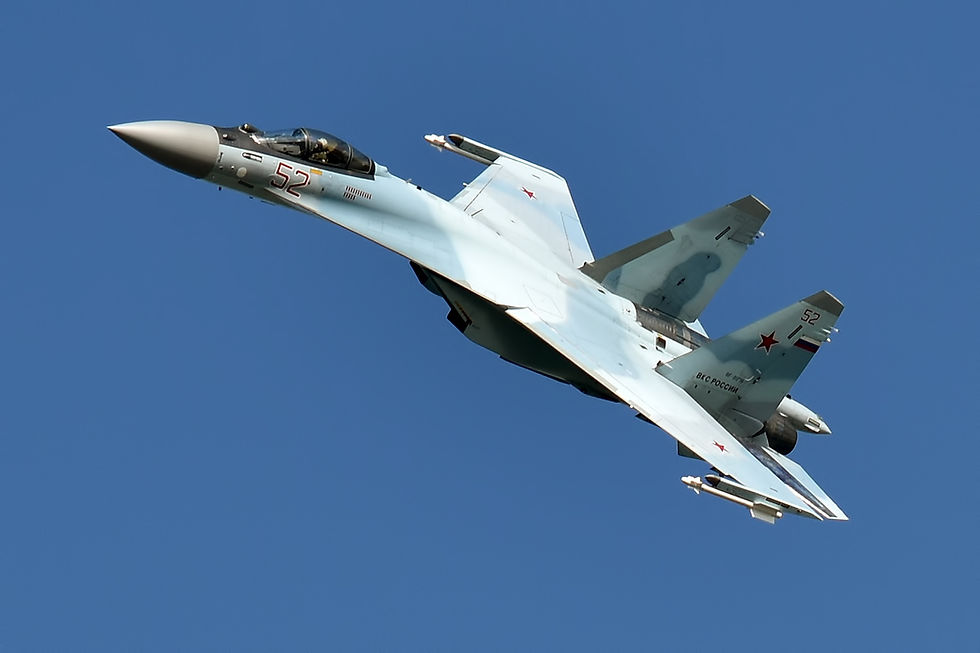
A Su-35S of the Russian Aerospace Forces. Fourteen new tactical fighters were delivered in the first eight months of 2026. Photo: Anna Zvereva, CC BY-SA 2.0, via Wikimedia Commons
The tactical fleet: the fighters that fly the Russian airpower war daily
Start with what the reference books say Russia has. The World Air Forces 2025 directory credits the VKS with about 142 or more Su-34 strike jets even after its losses, 118-plus Su-35S, 110-plus Su-30SM-family multiroles, roughly 175 Su-25 attack jets, and a MiG-31 interceptor force whose published estimates run so wide, from about 130 to nearly 250 depending on how stored airframes are counted, that the spread itself is the finding. These are paper numbers, refreshed slowly, and they count airframes rather than availability. But they set the scale: Russia's tactical air arm remains, on paper, one of the largest on earth.
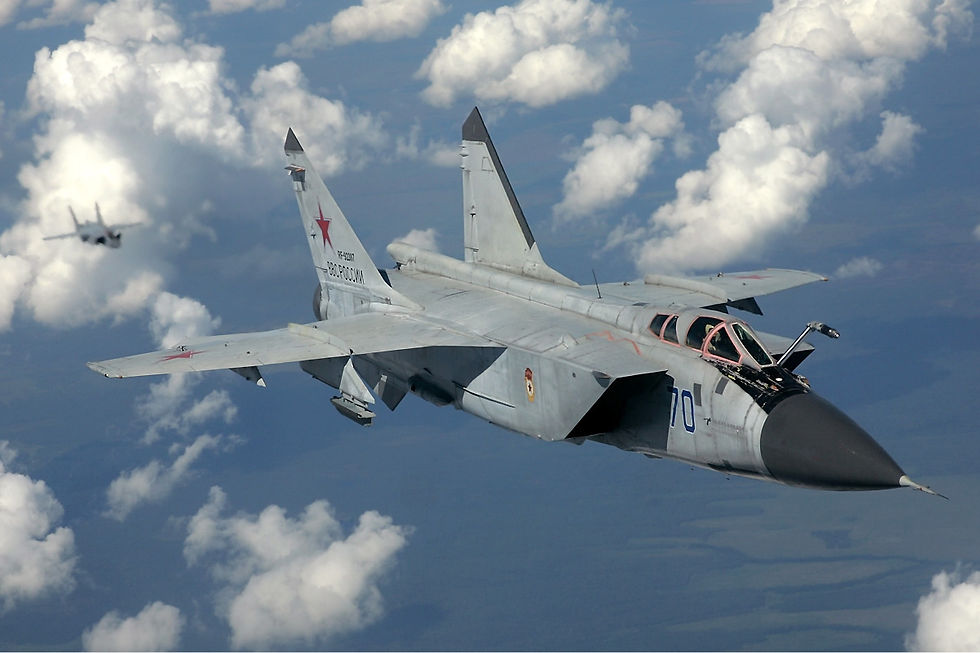
A MiG-31 interceptor. Published fleet estimates run from about 130 to well over 200, and the production line closed in 1994. Photo: Dmitriy Pichugin (GFDL 1.2), via Wikimedia Commons
Now subtract what part one established. Oryx has visually confirmed the destruction of 42 Su-34s, 41 Su-25s, 17 Su-30SMs and 8 Su-35S, and Defence24's aging analysis has roughly 550 of the 1,200 combat aircraft, led by the Su-24 and Su-25 fleets doing much of the daily flying, approaching the end of their structural lives. Fourteen new combat aircraft arrived in the first eight months of 2026 against at least ten lost or damaged, two of those heavy bombers. The tactical fleet is not collapsing. It is slowly thinning while flying harder than it ever has, and the thing keeping it relevant is the UMPK glide bomb kit, which lets a Su-34 fight from 60 kilometers behind the line.

Graphic: Project Leaflet
Where do they live now? Farther back every year, because Ukraine keeps proving the near bases are hittable. Marinovka, the Su-34 base in Volgograd oblast, lost two Fullbacks destroyed and two damaged to an SBU and Special Operations Forces drone strike overnight on June 26 to 27, 2025, confirmed in satellite imagery analyzed by Cyber Boroshno. Borisoglebsk, a Su-34 training hub, took a drone strike on its glide bomb depot in July 2025 and another on its fuel and bomb-kit storage in July of this year. In occupied Crimea, the SBU said it hit fighter jets in their hangars at Saky twice in one week in July 2026. Akhtubinsk, home of the flight test center, is where a Su-57 took drone damage back in June 2024. The pattern is the same one the bombers taught: the aircraft survive by moving back, and every kilometer of dispersal costs sortie rate, fuel, and airframe hours the aging fleet does not have.
The helicopter war: the one fleet that grew
Here is the number nobody expects after four and a half years of Lancet duels and FPV ambushes. Russia's Ka-52 fleet is bigger today than when the war started. GlobalMilitary.net's event database, cross-checked against Oryx, documents 42 Ka-52s lost since February 2022, 23 of them shot down, and yet counts roughly 138 in active service against about 119 before the invasion, because deliveries of new-build airframes, including the upgraded Ka-52M out of Arsenyev, have more than offset the losses. The wider rotary ledger per the same data: 29 Mi-8s, 17 Mi-24/35s and 13 Mi-28s lost, against a fleet the reference books still count in the many hundreds, including some 777 Mi-8 family transports and 94 Mi-28s. Oryx's own broader count, which includes damaged airframes, runs higher, around 68 Ka-52s and some 175 helicopters overall, and both things are true at once: heavy attrition, and a production line that outran it.

A Ka-52 Alligator. Russia's attack helicopter fleet is larger today than on the day of the invasion. Photo: Anna Zvereva, CC BY-SA 2.0, via Wikimedia Commons
The reason the fleet survived is that the helicopters stopped doing the thing that killed them. After the 2023 bloodletting, when Ka-52s ambushed the Ukrainian counteroffensive at Robotyne but died in numbers to MANPADS, and after long-range strikes on forward helicopter bases made massing rotary aviation near the front a gamble, Russian army aviation pulled back, switched to lofted rocket attacks and longer-ranged LMUR missiles, and ceded the close fight to FPV drones. The helicopters exist, and they are newer on average than in 2022. What they no longer do, on either side of the line, is own the battlefield sky.
The airlift, the tankers, and the quiet bottleneck
If the fighters are treading water and the helicopters are growing, the support fleets are where Russian airpower is thinnest, and this is the least reported part of the file. Start with the airlift. Russia operates roughly 110 to 130 Il-76 transports across its military transport aviation regiments, and in 2020 it announced four new regiments' worth of expansion, a target Defense Express prices at about 108 new aircraft. In the four and a half years of full-scale war, Ulyanovsk's Aviastar plant has delivered 24 new Il-76MD-90As, 26 counting the two handed over in 2021, per Defense Express: five in 2022, then six, six, and a record seven in 2025, a record that still leaves the four-regiment plan roughly a human generation from completion. Only one new regiment, the 600th, has even been announced as forming.

An Il-76MD-90A, the transport Russia can build, just not at scale: 24 delivered in the whole war against a 108-plane plan. Photo: Anna Zvereva, CC BY-SA 2.0, via Wikimedia Commons
The margins elsewhere are thinner still. The World Air Forces directory credits Russia with about 20 Il-78 tankers, the small fleet that makes everything else reach, including the 23-hour Ukrainka bomber commutes described in part one. The An-124 heavy-lift fleet is listed at five in military service, elderly airframes built around Soviet-era, Ukrainian-designed engines with no easy path to overhaul. And the transports have been dying too: the drone raid on Pskov air base in August 2023 left multiple Il-76s burning on the ramp, with open-source imagery confirming at least two destroyed, and Spiderweb claimed an An-12 at Olenya. None of this fleet can be risked near Ukraine, which is why Russian operational airlift now leans on rail, and why every Il-76 lost anywhere is felt everywhere.

Graphic: Project Leaflet
Naval aviation: carrier jets without a carrier
The strangest corner of Russian airpower in 2026 is the navy's. The Admiral Kuznetsov, Russia's only aircraft carrier, has not sailed since 2017; its endless refit was suspended entirely, and in July 2025 the chairman of Russia's state shipbuilding corporation, Andrei Kostin, said publicly that the ship will likely be sold or scrapped. Its air wing outlived it. Per Defense Express, the roughly 22 MiG-29Ks and 17 Su-33s of the 100th and 279th shipborne fighter regiments were folded into a new land-based Northern Fleet aviation corps, flying Arctic coastal defense from shore bases alongside Il-38 patrol aircraft and Ka-27 helicopters. Carrier aviation, as a Russian capability, has quietly ceased to exist; the pilots' deck qualifications are already a memory.

A Su-33 aboard the Admiral Kuznetsov in the 1990s. The carrier has not sailed since 2017; its jets now fly from shore. Photo: U.S. Department of Defense (public domain), via Wikimedia Commons
And even beached, the jets are not safe. In early September 2026, Ukraine's Unmanned Systems Forces claimed a Su-33 and an Mi-8 destroyed by long-range drones at Anapa, on the Black Sea coast, a claim later corroborated by satellite imagery for the Su-33, though Russian sources initially identified the jet as a Su-30. There are, at most, about seventeen Su-33s in existence. Losing one on a ramp 300 kilometers from the front is the naval aviation story in miniature: a shrinking, irreplaceable inventory being attrited in place. Behind it stand the fleet's other old birds, the Tu-142 and Il-38 patrol aircraft, Soviet airframes with no successor in production, doing NATO-facing work the war barely touches but age eventually will.
The edges of the force: radar planes, trainers, and the robot wingman
Three smaller files complete the picture. The special-mission fleet first: beyond the A-50 story from part one, Russia's roughly fifteen Il-20 and Il-22 intelligence and relay aircraft are the same vintage as its radar planes, and one Il-22M limped home with shrapnel damage the January 2024 night Ukraine downed the A-50 over the Sea of Azov. The training pipeline flies about 123 Yak-130s, per the World Air Forces count, one of the few modern fleets Russia has in depth, though a trainer fleet only matters if there is fuel, instructors and aircraft for its graduates.
Then there is the S-70 Okhotnik, the flying-wing strike drone that was supposed to be the Su-57's loyal wingman and the future of Russian combat aviation. On October 5, 2024, one flew out of control toward Ukrainian lines near Kostiantynivka and was shot down by its own escorting Su-57, per TWZ, which also reported the drone was armed when it went down. The wreckage landed in Ukrainian hands, an intelligence gift, and the program has been publicly quiet since. For a force whose future depends on unmanned mass, losing the flagship unmanned platform to friendly fire, over enemy territory, with the debris recovered by the other side, is the kind of detail that assessments are built from.
Why it matters
Put part one and part two together and the shape of Russian airpower in late 2026 is clear. The strategic tier is finite and shrinking. The tactical tier is huge on paper, thinning in practice, and utterly dependent on a cheap bomb kit for relevance. The rotary tier is the exception: the one place where Russian industry demonstrably replaces its losses and then some, even as tactics keep the survivors far from the front. And the enabling tier, the tankers, transports, radar planes and patrol aircraft that turn a collection of jets into an air force, is small, old, and effectively irreplaceable at wartime rates: 20 tankers, five heavy-lifters, a four-airplane radar picture, and an airlift plan running 84 airframes behind its own promise. Air forces do not usually die at the fighter squadron level. They die in the enabling tier, quietly, one unreplaced Il-76 at a time. That is where Russian airpower is most fragile, and, for Ukrainian planners reading the same open sources we do, where the highest-value targets have always been.
What to watch
The Il-76MD-90A delivery count for 2026, because it is the cleanest public indicator of whether Russian aviation industry can grow anything at scale. Whether Ka-52M deliveries keep pace as Western components in its optics and electronics get harder to source. Any sign of the S-70 program resurfacing, or of the Okhotnik's teardown showing up in Ukrainian targeting. Whether the beached carrier jets at Severomorsk and Anapa keep appearing in strike footage. And the tactical dispersal map: every time a Su-34 regiment moves another hundred kilometers from the border, Ukraine's deep-strike campaign has done its job without firing a shot.
The channel counts the whole force, not just the famous parts. The daily tape runs live at t.me/TheLeaflet, and the morning brief is here every day in The Daily Sitrep.
Read next: What Is Left of the Russian Air Force: The Bases We Can Count, the Bombers They Cannot Replace | The ASC 890 Is Flying: Ukraine Confirms Six Months of Combat Missions for Its Swedish Radar Plane
Want the recap in your inbox? The channel sends one Sitrep Digest email on the 1st of each month, the best of the morning briefs in a five minute read. Drop your email in the subscribe box at the bottom of this page.
Sources
This assessment draws on World Air Forces 2025 fleet data, Oryx via Aerospace Global News, GlobalMilitary.net's loss database, Defense Express and Defence24, Militarnyi and Cyber Boroshno satellite analysis, TWZ, United24 Media, Euromaidan Press, and Meduza on the Kuznetsov as cited, the SBU and Ukraine's Unmanned Systems Forces for attributed claims, and the channel's own prior reporting, including part one of this assessment. Confirmed counts are minimums; claims are labeled. Photo credits appear beneath each image.


Comments