


Ukraine Starlink Restrictions: Missing Missile Warnings, 39 Ballistic Missiles, and a Ceasefire in Name Only

Updated: 2 days ago

In brief: Russia's overnight October 13 to 14 strike put 39 ballistic missiles and 128 drones into Ukraine's grid, killed at least 10 people and left more than 600,000 without power, three days after Washington announced an energy ceasefire. Kyiv got no launch warning from its partners for the second night running, and SpaceX capped Starlink speeds for moving terminals the same night.
Part of our Ukraine War Analysis coverage.
The sirens in Kyiv sounded late again. In the small hours of Tuesday night into Wednesday, October 14, Ukrainian radars picked up Russia's ballistic missiles only as they closed on the capital, and President Volodymyr Zelensky posted the sentence that has defined this week of the war: once again, no early warning from our partners.
By morning the scale was clear. The Ukrainian Air Force counted 167 air attack weapons overnight: 39 missiles of the Iskander-M, KN-23, S-400 and hypersonic Zircon and Onyx types, plus 128 Shahed-type drones, 77 of them jet-powered. Air defense neutralized 115 drones, about 90 percent, but just 4 of the 39 missiles. Strikes landed at 22 locations. And while the missiles were in the air, Ukrainian operators discovered that SpaceX had quietly capped the speed of Starlink terminals in motion. The new Ukraine Starlink restrictions, imposed without notice on the same night Kyiv's warnings went dark, are the story inside the story.
39 Ballistic Missiles and 600,000 People in the Dark
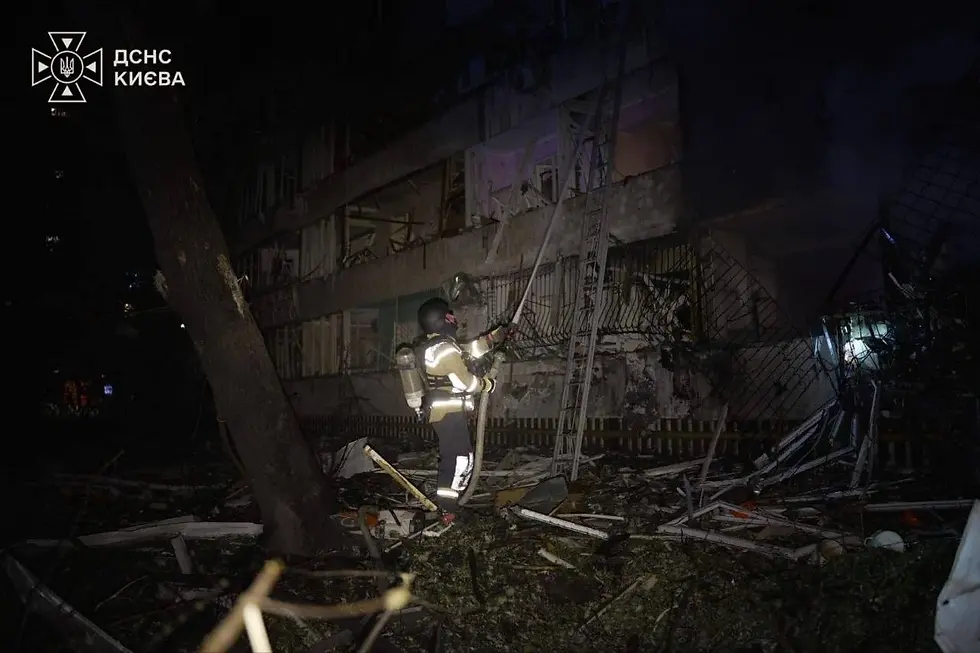
Zelensky said the main target was energy, specifically Kyiv's CHP-4 combined heat and power plant, and that the barrage damaged 26 elements of the electric power system and four oil and gas facilities. More than 600,000 people lost electricity. DTEK declared emergency outages in five Kyiv districts, water pressure dropped in the Pecherskyi district, and Ukrzaliznytsia suspended the Kyiv City Express while the ballistic threat lasted.
The human toll ran past the grid. A missile hit a nine-story residential building in Kyiv's Desnianskyi district, killing three women and injuring more than 20 people, including a seven-year-old girl, according to the Kyiv City Prosecutor's Office; one more person was killed in the Holosiivskyi district. Across the country, authorities counted at least 10 killed and 91 injured over the past day as of early Wednesday afternoon, per the Kyiv Independent's tally. Monitoring channels cited by United24 Media reported a record barrage of roughly 25 Zircon hypersonic missiles aimed at Kyiv, a figure the Air Force has not confirmed.
Destruction at the nine-story residential building hit in Kyiv's Desnianskyi district, October 14. Photo: ArmyInform, CC BY 4.0
No Early Warning, for the Second Night Running
The pattern began two nights earlier. Late on Monday, October 12, ballistic missiles hit Kyiv with sirens sounding only after the first impacts; the Associated Press put the count at five. Zelensky called that strike particularly vile and wrote that early warning about ballistic launches helps prevent people from being killed. The United States can detect Russian ballistic launches at ignition and has routinely passed that data to Kyiv, where it feeds public alerts and air defense cueing.
Asked about it at the White House on Tuesday, President Donald Trump said the US has not stopped sharing intelligence with Ukraine. A senior Ukrainian official told the AP the lapse was described to Kyiv as a failure, possibly tied to circumstances like weather rather than a decision. But the gap did not close: the far larger barrage overnight into Wednesday arrived, in Zelensky's words, once again without warning. The Kyiv Independent has reported that Washington threatened at the October 9 and 10 Miami talks to cut intelligence sharing and arms sales unless Ukraine stopped hitting Russian refineries; the channel covered the ultimatum behind the energy ceasefire and the ceasefire violations that followed. Two nights of silence are not proof of a cutoff. They are proof that the warning pipeline Ukraine built its ballistic defense around can no longer be assumed.

Emergency crews work at a fire after the overnight strike on Kyiv, October 14. Photo: ArmyInform, CC BY 4.0
Ukraine Starlink Restrictions: A 100 MPH Cap With No Notice
The same night, the other pillar of Ukraine's battlefield connectivity shifted. Serhii Beskrestnov, the signals specialist known as Flash who advises Ukraine's forces on communications, reported that SpaceX imposed a speed limit on Starlink terminals in motion overnight, capping terminals on the military StarShield package at 100 miles per hour. Tonight SpaceX introduced a speed limit for the Starlink terminals in motion, he wrote, saying the move came with no warning, disrupted several missions, and that this action cannot be a coincidence.
Volunteer Serhii Sternenko relayed harsher field reports: operators seeing connectivity degrade from roughly 60 to 70 kilometers per hour, well below the nominal cap. Starlink carries command posts, mobile units, drones and reconnaissance teams, so a motion cap bites hardest on exactly the fast platforms Ukraine uses to offset Russian mass. SpaceX has not commented. Whether the cap is a technical change or another turn of the pressure campaign, it landed on Ukrainian screens in the same week as the Trump Russia diesel deal, the missing warnings, and Trump's public refusal to blame Moscow.
A Ceasefire in Name Only
Three days after Trump announced that both sides had agreed to stop striking energy targets, Russia's Defense Ministry described Wednesday's attack as a massive strike on energy and communications infrastructure, claiming hits on two Kyiv power and heating plants and a thermal power plant in Kharkiv region. Trump, asked Tuesday whether Russia had violated his ceasefire, said I'll let you know about that later, and noted that Ukraine hit many sites the day before. Zelensky's answer came in the morning: the strike was entirely deliberate and demonstrative in its scale, he wrote, calling it ostentatious disrespect toward the United States. He asked Washington for two concrete things: sanctions under the bill bearing Senator Lindsey Graham's name, and more Patriot interceptors, which the AP notes remain scarce in part because of the US war with Iran.
Ukraine's own long-range campaign did not pause either. Kyiv says it has held fire on refineries since Sunday, but data centers are another matter: Russia's Defense Ministry claimed its air defenses downed 902 Ukrainian drones overnight, with Moscow Mayor Sergei Sobyanin reporting nearly 500 headed for the capital region, reported claims the channel cannot verify. A drone killed one person in Balakovo in Saratov region, where Sberbank said its data center was attacked but kept running, part of the target set we profiled in the Yandex data center strikes.

Firefighters at a strike site during the overnight attack of October 14. Photo: ArmyInform, CC BY 4.0
Why It Matters
Air defense is a kill chain, and the first link is warning. Ukraine can intercept ballistic missiles only with Patriot, and Patriot works best when launch data arrives at ignition, not when a city's radars catch the terminal dive. Remove early warning and cap the communications of moving units, and Ukraine's two scarcest commodities, interceptors and reaction time, both get scarcer without a single sanction lifted or law changed. That is leverage that never has to announce itself. The three days since the energy ceasefire was declared have delivered the war's bluntest demonstration that Ukraine's defense now depends on infrastructure owned by partners whose priorities are shifting.
What to Watch
Watch three things. First, whether launch-warning data visibly returns: the fastest tell will be sirens that precede impacts in the next ballistic attack on Kyiv. Second, whether SpaceX explains or reverses the motion cap, and whether units report workarounds or further tightening. Third, sanctions: Zelensky has asked for the Graham bill to be applied after this strike; if the diesel waiver stands while sanctions stay unused, Kyiv will draw its own conclusions before the deep winter strikes begin.
The channel will be tracking the warning gap and the Starlink data as units report in. For the live feed, find us on Telegram at t.me/TheLeaflet.
Read next: Energy Ceasefire Violations: Six Grid Strikes, Missiles Before the Sirens, and Lavrov's No and Zircon Missile Attack on Kyiv: Russia Opens the Winter Grid War.
Want this level of analysis in your inbox? Drop your email in the subscribe box at the bottom of this page and the channel will send you the Sitrep Digest: the best of these briefs in a five minute read.
Reader question: do you read the missing warnings and the Starlink cap as deliberate pressure on Kyiv, or as the friction of a distracted ally? Drop your take in the comments, and tell the channel what you want covered next.
Sources
Ukrainian Air Force figures via NV (Oct 14, 2026); Kyiv Independent (Oct 13 and Oct 14, 2026); Al Jazeera (Oct 14, 2026); United24 Media (Oct 14, 2026); AP via PBS NewsHour (Oct 13, 2026); Euronews (Oct 14, 2026); ArmyInform (Oct 14, 2026). Photos: ArmyInform, CC BY 4.0.


Comments