


Ukraine War This Week: 115 Missiles, a Toll of 55, and the Abu Dhabi Clock


In brief: Russia fired 115 missiles, nearly 1,900 guided bombs and more than 3,000 attack drones at Ukraine this week, and on the worst night only 4 of 36 ballistic missiles were intercepted. With 850,000 customers in the dark, the Komyshuvakha toll at 55, and trilateral talks set for Abu Dhabi on November 10 and 11, the winter war and the peace push now run on the same clock.
Part of our Ukraine War Analysis coverage.
What happened in Ukraine this week? Arithmetic. Russia fired 115 missiles, nearly 1,900 guided bombs and more than 3,000 attack drones in seven days, by President Volodymyr Zelensky's Sunday tally, and on the worst night Ukraine stopped 4 of 36 ballistic missiles. The same week produced a date: November 10 and 11, Abu Dhabi, trilateral. The blackouts, bridge strikes and refinery fires all read as positioning for that table.
Ukraine war this week: 115 missiles and a broken ballistic shield
Zelensky attached an ask to the Sunday tally: a 22nd EU sanctions package aimed at Russia's missile production lines, since a significant share of this week's missiles were manufactured this year, per Kyiv Post. These are combined strikes built around ballistic missiles, he said.
The worst night came Saturday, November 7. Russia fired 36 ballistic missiles and Ukraine shot down four, Zelensky said; by preliminary data, North Korean KN-23 missiles hit one key energy facility. Six ballistic missiles targeted Kyiv's Pivnichnyi Bridge and four hit it, closing the crossing in both directions, per Mayor Vitali Klitschko. It is the second Dnipro crossing Russia has hit in a month, after October's strikes on the Southern Bridge, and Zelensky had warned a day earlier, citing intelligence, that strikes on energy, bridges and civilian infrastructure were being prepared.
The interception rate is the story. Kyiv Post describes an acute deficit of anti-ballistic interceptors, Berlin said this week it has no more Patriots to send for now, per Euromaidan Press, and October's 500 approved PAC-3s exist on paper, not in launchers. The week opened the same way: the barrage into November 3, timed to the US midterms, carried 76 missiles, 17 of them ballistic.
The grid war: 850,000 in the dark as the first snow falls
Overnight into Sunday, Russia sent 3 Kh-59/69 missiles and 164 Shahed type drones, 112 of them jet powered, at power facilities across several oblasts; Ukraine's Air Force downed 137 and recorded hits at 23 locations. By morning, more than 600,000 customers were without power in five districts of Dnipropetrovsk Oblast, with hospitals on generators, per oblast head Oleksandr Hanzha, and about 250,000 more in Kharkiv Oblast after a single drone found a critical infrastructure facility, per Zlatopil Mayor Mykola Baksheiev.
In Zhytomyr Oblast, strikes hit heat and power facilities in four communities: 140 apartment blocks in the city lost heating with temperatures near freezing, more than 312,000 customers moved to hourly outages, and drones destroyed the Ovruch substation outright, the city council warning of a long blackout. Emergency cuts followed in Kharkiv, Poltava, Sumy and, by midday, Kyiv Oblast.
The most dangerous line came from Energoatom: the occupied Zaporizhzhia Nuclear Power Plant lost its last external line at 2:36 a.m. and is on diesel generators alone, its 16th full blackout of the year. A drone killed one person in a Dnipro suburb, shelling killed one in Odesa, and by evening Dnipropetrovsk Oblast counted two dead and seven wounded, per ArmyInform.
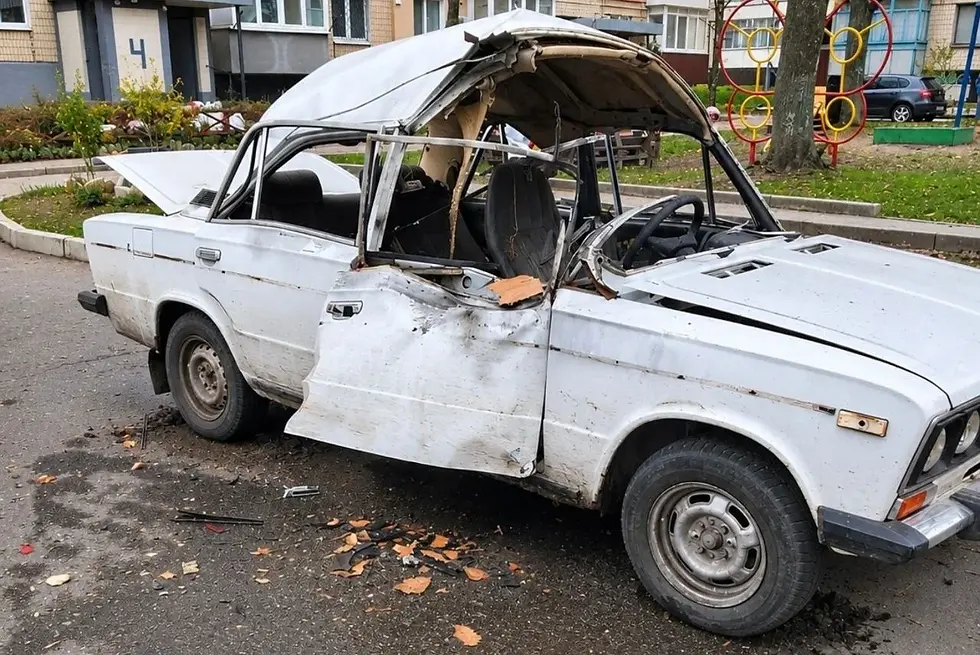
Aftermath of Russian strikes in Dnipropetrovsk Oblast, November 8, 2026. Photo via ArmyInform (CC BY 4.0).
Komyshuvakha: a toll of 55, and drones on the rescuers
The deadliest single event of the war's autumn kept getting worse. On Monday, November 2, Russian aircraft dropped at least nine guided bombs, including FAB-3000s, on a school in Komyshuvakha, Zaporizhzhia Oblast, used every Monday to hand out humanitarian aid, then hit the shelter people ran to. By Sunday, rescuers had recovered 55 bodies, with around 45 people still listed as missing, per the oblast administration. Four police officers and two rescuers, Denys Konovalenko and Oleksii Sushchevskyi, both 44, are among the dead.

Search and rescue operations at the destroyed school in Komyshuvakha. Photo: Interior Ministry of Ukraine, via ArmyInform (CC BY 4.0).
On Sunday morning, the seventh day of the search, Russian drones attacked the rescuers three times. The second strike hit a fire and rescue vehicle and wounded its driver; an hour later, as crews evacuated the damaged equipment, a third strike wounded another driver, per the State Emergency Service.

A DSNS fire and rescue vehicle hit by a Russian drone during search operations in Komyshuvakha, November 8, 2026. Photo: DSNS via ArmyInform (CC BY 4.0).
The deep-strike ledger: Saratov burns, a Neptune reaches Oryol
Ukraine's answer ran all week. Overnight into Saturday, drones set Rosneft's Saratov refinery burning, a 7 million ton per year plant, per OSINT analysts at ASTRA who geolocated eyewitness video; Governor Roman Busargin confirmed damage and casualties without naming the plant, and the Kyiv Independent could not verify the strike, the refinery's third reported hit this fall.
The same night brought a confirmed strike: Ukraine's General Staff said coastal Neptune missiles hit Proton-Elektroteks in Oryol, which supplies semiconductors for Iskander-M missiles and Pantsir-S1 systems, with direct hits and secondary detonations, while a warehouse burned in Rostov, per Militarnyi. Add Friday's reported Afipsky refinery fire, and the week fits the ledger Kyiv published days earlier: 15 of Russia's 38 major refineries suspended, output down 55 percent, per Ukrainian military intelligence.
Sunday morning, the campaign touched the road to Crimea: drone debris damaged a bridge over the Mius River at kilometer 97 of the R-280 Novorossiya highway in Rostov region. Governor Yuri Slyusar first announced alternating one way traffic, then closed the section entirely, per Militarnyi.
The front line: no Russian advance on the week's hottest axes
The map barely moved, and where it moved, it moved Ukraine's way. ISW assessed on November 7 that Russian forces attacked in the Kostiantynivka direction, around Dobropillya and toward Hulyaipole without advancing, with Ukrainian counterattacks in the Hulyaipole direction. The week's one geolocated change was Ukrainian: an advance in central Mala Tokmachka, southeast of Orikhiv, per footage published November 7.
Ukraine's General Staff counted roughly 190 combat engagements a day, with Kostiantynivka the fiercest sector, per Ukrinform. Kyiv's claim of 16,130 Russian casualties would be Russia's worst week of the war by Ukraine's count; the figure is one side's. Behind the line, Ukraine's ground drones ran a record 31,398 verified missions in October.
Diplomacy: the Abu Dhabi clock, and Europe's red line
The table is set. US envoy Steve Witkoff announced Monday that Washington will bring Ukrainian and Russian delegations together in Abu Dhabi on November 10 and 11 for post-war security agreements, de-escalation, humanitarian measures and ending the war, per Reuters. Trump spent the week predicting a very big deal extending beyond Ukraine, per Kyiv Post, days after receiving Kremlin envoy Kirill Dmitriev in the Oval Office, and Jared Kushner said Washington is working on a broader European security architecture.
Europe answered from Warsaw on Friday. We will not implement it, EU foreign policy chief Kaja Kallas said of any US-Russia security deal negotiated without Europe: sanctions, frozen Russian assets and Ukraine's EU accession all run through Brussels. Poland's Radoslaw Sikorski called a deal over Europe's head impossible, Ukraine's Andrii Sybiha said Russia cannot be a security guarantor for the continent, per Kyiv Post, and by Sunday France confirmed Europeans will be represented in Abu Dhabi, per Foreign Minister Jean-Noel Barrot.
Zelensky's framing of the week's violence points at the same table: Russia treats diplomacy as a subtype of aggression, he said, using the strikes to build pressure on Ukraine and its partners before the talks. Kyiv arrives carrying a domestic wound too: the Operation Carthage corruption case that reached inside the SBU this week.
Why it matters
Remember 4 of 36. Russia saved its heaviest ballistic salvos for the week before the talks because the interceptor math finally favors it, and every blacked-out oblast is a bargaining chip. If Abu Dhabi produces an energy ceasefire, it will be because the grid war made one urgent; if it produces nothing, the grid war is the plan for the winter.
What to watch next week
Whether Abu Dhabi produces real language on security guarantees or a revived energy ceasefire, and whether Europe's seat is substantive. Whether Russia keeps shooting at Dnipro bridges. How long the Zaporizhzhia plant's diesel holds. The shape of the EU's 22nd sanctions package. And whether the refinery campaign pauses for the talks or accelerates.
The channel will be reading the Abu Dhabi tea leaves. For the daily brief, follow t.me/TheLeaflet.
Read next: Patriot Missile Sale to Ukraine: 500 PAC-3 Interceptors on Paper and Russia Energy Attacks Are War Crimes: The UN Verdict.
Want this level of analysis in your inbox? Drop your email in the subscribe box at the bottom of this page and the channel will send you the Sitrep Digest: the best of these briefs in a five minute read.
A question for the regulars: when the Abu Dhabi readouts land, what should the channel unpack first, the security guarantee language, the energy ceasefire mechanics, or the map? Drop it in the comments or tell the channel what to cover next.
Sources
Kyiv Post (Nov 7-8, 2026); Ukrinform (Nov 7-8, 2026); Euromaidan Press (Nov 8, 2026); Kyiv Independent (Nov 7, 2026); Militarnyi (Nov 7-8, 2026); Reuters (Nov 2, 2026); ISW (Nov 7, 2026); Al Jazeera (Nov 8, 2026); ArmyInform and DSNS (Nov 6-8, 2026). Photos: Interior Ministry of Ukraine and DSNS via ArmyInform, CC BY 4.0.


Comments